Super Midsize Jet
Bombardier Challenger 300
Range
3,100 NM
Cruise speed
470 kts
Seats
8
History
Bombardier unveiled the aircraft at the Paris Air Show in 1999 as the Continental project, and it later took the name Challenger 300. It was an all-new design, positioned between the Learjet 60 and the Challenger 604 to give Bombardier a contender in the super-midsize class.
The avionics suite, Pro Line 21, came from Rockwell Collins, while AlliedSignal provided the AS907 turbofans. The prototype first flew on 14 August 2001 from Bombardier's facility in Wichita, but engine delays stretched the certification timetable. Transport Canada approved the type on 31 May 2003, the FAA on 4 June and the European JAR 25 authorities on 31 July.
Flexjet took the first aircraft into service on 8 January 2004. Bombardier priced the 300 below its rivals at launch while offering more range and a more comfortable cabin, and it went on to become one of the most popular jets in its class. Production ended in 2014, and the design lives on in the Challenger 350.
Technical Specifications
General information
| Model name | Challenger 300 |
|---|---|
| Manufacturer | Bombardier |
| Aircraft category | super midsize jet |
| ICAO Designator | CL30 |
| Start/End of Production | 2003 - 2014 |
| Number of pilot(s) | 2 |
Performances
| Range (with IFR reserves) | 3100 NM (5741 km) |
|---|---|
| Ferry range | 3300 NM (6112 km) |
| Cruise speed | 470 kts (870 km/h) |
| Max Operating Speed – VMO | 320 KIAS |
| Max Mach Operating Speed - MMO | Mach 0.83 |
| Long-Range Cruise Speed - LRC | 459 KTAS |
| Approach Speed | 115 kts |
| Takeoff Distance | 1470 m |
| Average Landing Distance | 790 m |
| Rate of Climb | 5000 ft/min |
| Service Ceiling | 45000 ft |
| Thrust | 6826 lbf |
Aircraft technology
| Engine type | Turbofan |
|---|---|
| Engine(s) | 2 |
| Avionics | Rockwell Collins ProLine 21 |
Dimensions and capacity
| Aircraft length | 20.92 m |
|---|---|
| Aircraft height | 6.2 m |
| Wing span | 19.46 m |
| Cabin height | 1.86 m (6.10 ft) |
| Cabin length | 7.68 m (25.20 ft) |
| Cabin width | 2.19 m (7.20 ft) |
| Baggage volume | 3 m3 |
| Seats (standard config) | 8 |
| Seats (max) | 10 |
| Suitcases | 8 |
| Carry-on luggage | 8 |
| Maximum payload | 1600 kg |
| Maximum TakeOff Weight - MTOW | 17600 kg |
| Maximum Landing Weight - MLW | 15300 kg |
| Fuel capacity | 8000 L |
FAQ
What is the difference between the Challenger 300 and the Challenger 600 series?
The 300 is a super-midsize aircraft for 8 passengers in standard layout, with 3,100 nm (5,741 km) of range, good runway performance and lower operating costs, which makes it a natural fit for city-to-city business trips. The 600 series are wide-cabin heavy jets that usually seat 9 and fly further: 3,756 nm for the 604 and 605, and 4,000 nm for the 650. Choose the 300 for economy and airport access, the 600 series for intercontinental reach.
Can the Challenger 300 cross the Atlantic without stopping?
On many routes, yes. Its range with IFR reserves is 3,100 nm (5,741 km), which covers New York from London and Geneva from Dubai without a fuel stop. Passengers, baggage and weather all affect the figure on a given day, and our advisors confirm the plan for each trip.
What is the Challenger 300 cabin like?
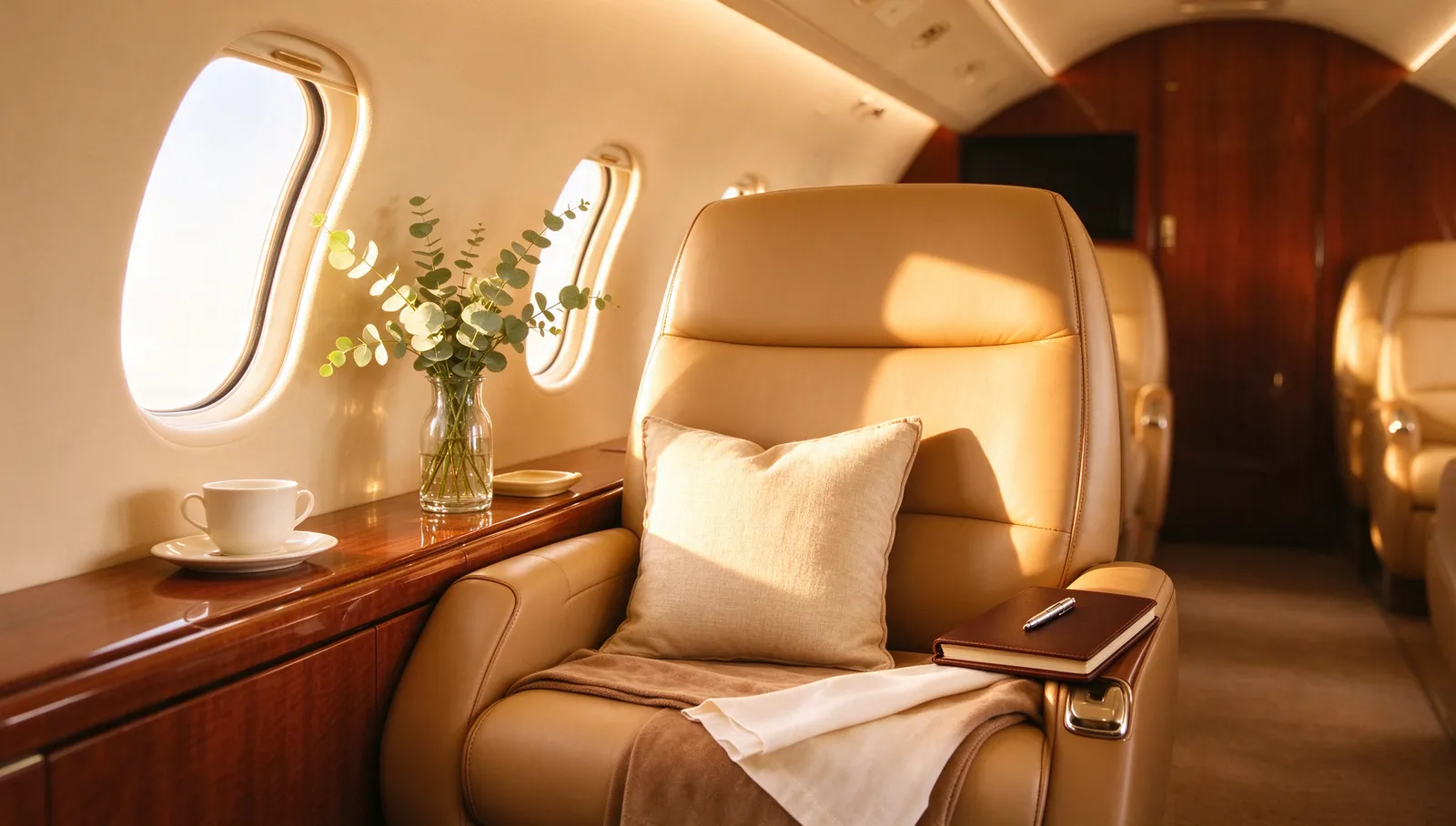
The cabin has a flat floor and enough height to stand, at 1.86 m, so passengers can move around freely in flight. Every seat has a large window, the usual layout is for 8, and the cabin includes a private lavatory plus a galley that is well equipped. It feels like a larger jet while keeping the running costs of a super-midsize.
Is the Challenger 300 still available to charter?
Yes. Bombardier certified it in 2003, it entered service in 2004 and production ended in 2014, when the improved Challenger 350 took its place. Plenty of 300s remain active, and it is one of the easier super-midsize jets to find on the charter market.
Gallery
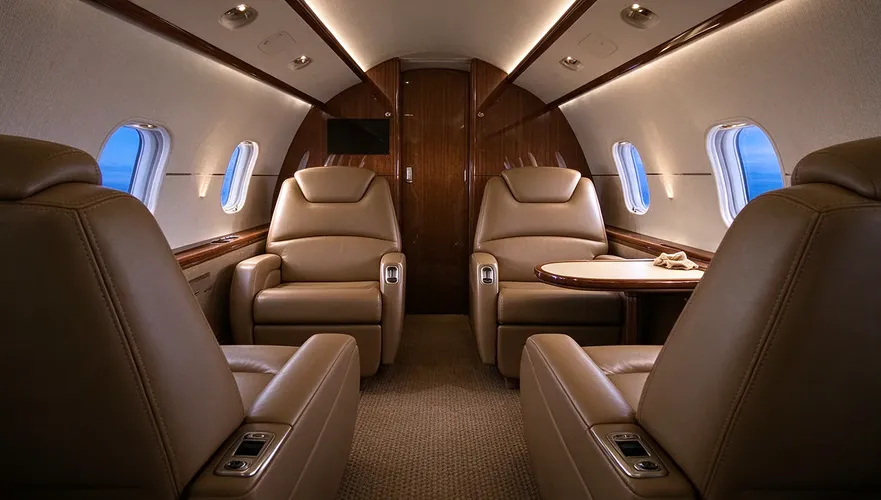
Figures are published manufacturer data, shown for illustration only. Images are generated for this concept and show the Challenger 300 type, not a specific aircraft. Bombardier and Challenger 300 are trademarks of their owner, used only to identify the aircraft.