Large Jet
Bombardier Challenger 650
Range
4,000 NM
Cruise speed
470 kts
Seats
10
History
Bombardier builds the Challenger 650 in Québec, Canada, and has produced it since 2015. It updates the Challenger 605 with two extra seats, for a maximum of 12 passengers, and with higher-thrust engines that shorten the take-off run. The galley was also redesigned so the crew can prepare meals on board more quickly.
The family goes back to 1980, when Canadair delivered the first production CL-600. Its selling points were a roomier cabin and lower fuel consumption than rival large jets of the time, many of which had narrower fuselages. Sales were slow at first, with only 10 aircraft sold by 1982.
The turning point was the CL-601, which replaced the original Lycoming engines with General Electric CF34 turbines, a change industry observers credit with lifting sales. Bombardier took over Canadair in 1986 and, helped by a fuselage the original engineers had designed to be stretched, developed the line into several models. Deliveries passed 500 in May 2000 and reached 1,000 in December 2015.
North America is home to more than half the Challenger 650 fleet, Europe to about 30 percent and Asia to a smaller share. Besides business and charter flying, the type also works as an air ambulance: Swiss Air-Rescue (Rega) has operated it in that role since 2018.
Technical Specifications
General information
| Model name | Challenger 650 |
|---|---|
| Manufacturer | Bombardier |
| Aircraft category | large jet |
| ICAO Designator | CL60 |
| Start/End of Production | 2015 - Still in production |
| Number of pilot(s) | 2 |
Performances
| Range (with IFR reserves) | 4000 NM (7408 km) |
|---|---|
| Ferry range | 4000 NM (7408 km) |
| Cruise speed | 470 kts (870 km/h) |
| Max Operating Speed – VMO | 348 KIAS |
| Max Mach Operating Speed - MMO | Mach 0.85 |
| Long-Range Cruise Speed - LRC | 425 KTAS |
| Approach Speed | 128 kts |
| Takeoff Distance | 1719 m |
| Average Landing Distance | 732 m |
| Rate of Climb | 4300 ft/min |
| Service Ceiling | 41000 ft |
| Thrust | 9220 lbf |
Aircraft technology
| Engine type | Turbofan |
|---|---|
| Engine(s) | 2 x General Electric CF34-3B MTO |
| Avionics | Bombardier Vision (Pro Line Fusion) |
Dimensions and capacity
| Aircraft length | 20.9 m |
|---|---|
| Aircraft height | 6.3 m |
| Wing span | 19.6 m |
| Cabin height | 1.83 m (6.0 ft) |
| Cabin length | 7.80 m (25.58 ft) |
| Cabin width | 2.41 m (7.92 ft) |
| Baggage volume | 3.26 m3 |
| Seats (standard config) | 10 |
| Seats (max) | 12 |
| Suitcases | 10 |
| Carry-on luggage | 10 |
| Maximum TakeOff Weight - MTOW | 21863 kg |
| Maximum Landing Weight - MLW | 17237 kg |
| Fuel capacity | 9163 L |
Advantages & Disadvantages
Advantages
- Economical to operate: Spare parts are inexpensive, maintenance intervals are long and fuel efficiency is good. Charter clients see the benefit in the price, particularly on longer trips where variable costs make up most of the bill. The engines, refined from those on the 605, add take-off thrust while burning less fuel in cruise.
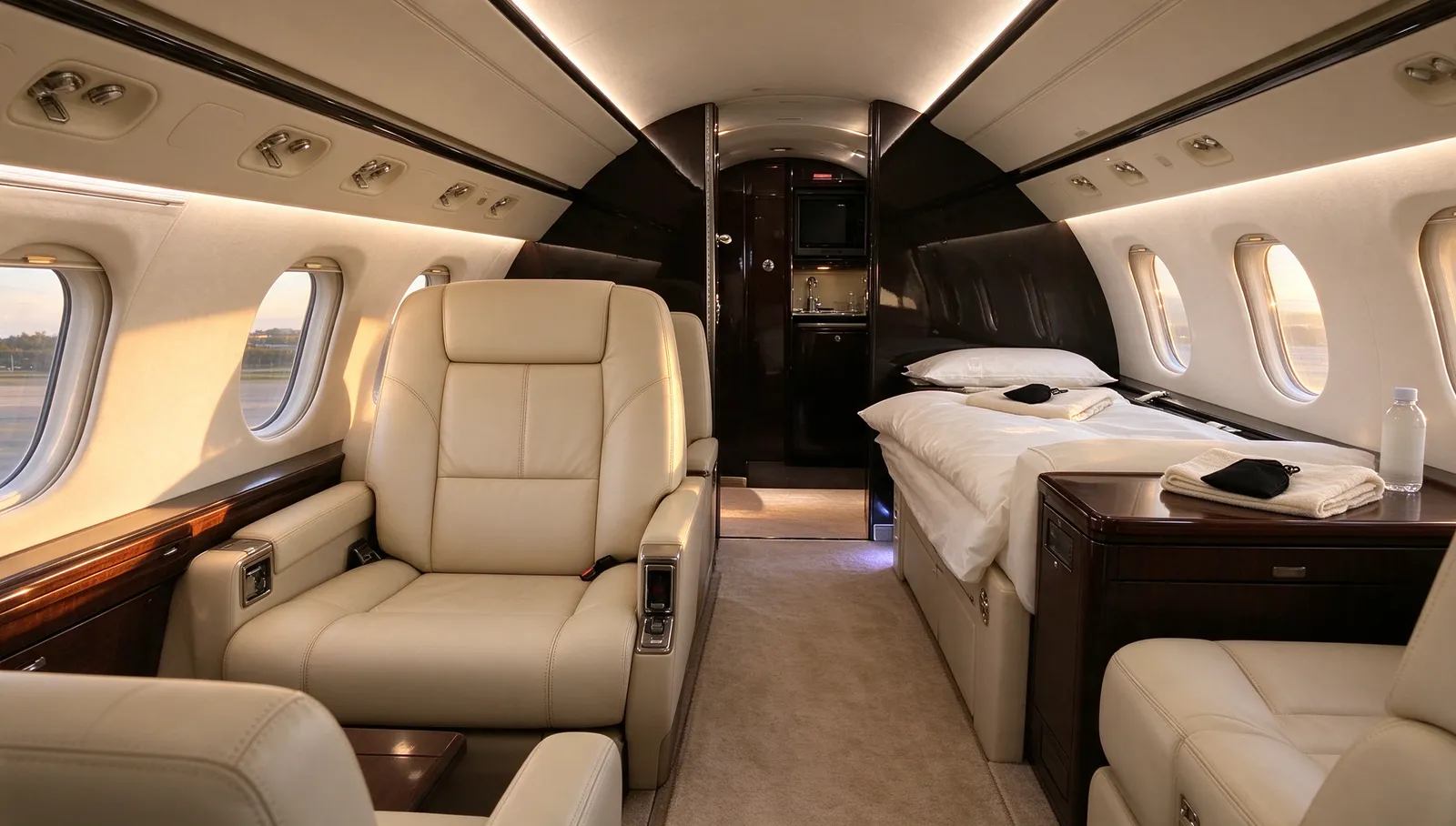
- Room to move: Space is the 650's strongest point on long flights, with large seats that convert into beds, big windows, angled touchscreens and real wood finishes.
- A unified interior: Bombardier designed the cockpit and cabin as a single whole, and the detailing of the seats and trim takes its cues from fine furniture and high-end car interiors.
- Fast connectivity: Bombardier was the first manufacturer to offer Ka-band high-speed internet in a large business jet, in 2017, with global satellite coverage. Passengers can browse, stream video and join video calls much as they would on the ground.
- A proven family: No business jet family has sold better in recent decades than the Challenger line, and its comfortable cabin, smooth handling in flight and low operating costs keep it in demand through market ups and downs.
Disadvantages
- Purchase cost passes through: The Challenger 650 is expensive to buy, and that cost is reflected in charter rates, most of all on short flights. Because so many are in service, prices can soften when demand is low.
- Large for small groups: Its cabin and range let up to 12 passengers and their luggage travel long distances in comfort, which is where it outperforms smaller jets. For a short trip or only a few passengers it can be more aircraft than needed, and the smaller Challenger 350 is worth considering.
FAQ
How many passengers can travel on a Challenger 650?
The standard layout seats 10, and the maximum is 12. At 2.41 m wide and 1.83 m high, the cabin leaves room to work or rest even when every seat is taken. The 3.26 cubic metre baggage hold fits about 10 suitcases plus carry-on bags.
What range does the Challenger 650 have?
With IFR reserves it flies 4,000 nm (7,408 km). That is enough to reach London from New York, or Paris from Dubai, without stopping, subject to weather and the number of passengers on board. Cruise speed is 470 kts (870 km/h), and the long-range cruise setting is 425 KTAS.
Which airports can a Challenger 650 use?
It can use many airports with runways too short for other heavy jets. Steep-approach certification gives it access to London City, Aspen and Lugano, which is useful for business centres and mountain destinations where access is usually restricted. Take-off distance is 1,719 m and average landing distance 732 m, and our advisors check each airport against the aircraft's performance and the operator's approvals.
How much does it cost to charter a Challenger 650?
Prices are set trip by trip. Route length, the dates you fly, the position of the nearest suitable aircraft and the operator's rates all feed into the quote, and longer sectors tend to make good use of the 650's low operating costs. Tell our advisors where and when you want to go, and they will price the trip for you.
Challenger 650 or Challenger 350: which suits my trip?
The 650 is the large-cabin option, with 10 seats in standard layout and a range of 4,000 nm (7,408 km). The 350, a super-midsize jet, carries 8 to 10 passengers and has about 3,200 nm (5,926 km) of range. They come from the same mid-2010s Bombardier generation but do different jobs: choose the 650 for space and baggage capacity, and the 350 for efficient medium-range flying.
Is the Gulfstream G400 a better option than the Challenger 650?
The G400, launched in 2021, flies further, at about 4,200 nm (7,780 km) against 4,000 nm, cruises slightly faster and has more cabin volume overall. Even so, no other jet in its class has a wider cabin than the Challenger 650, and its baggage hold is bigger too, two things that make a practical difference on many charter trips.
Challenger 650 or Falcon 2000LXS: what separates them?
The two look alike from the outside, and their cabin dimensions are almost the same. The differences show up in the detail: the Challenger offers about 10 percent more cabin volume, while the Falcon has a higher maximum weight and more range. For most charter trips the choice comes down to whether cabin space or range matters more.
Gallery
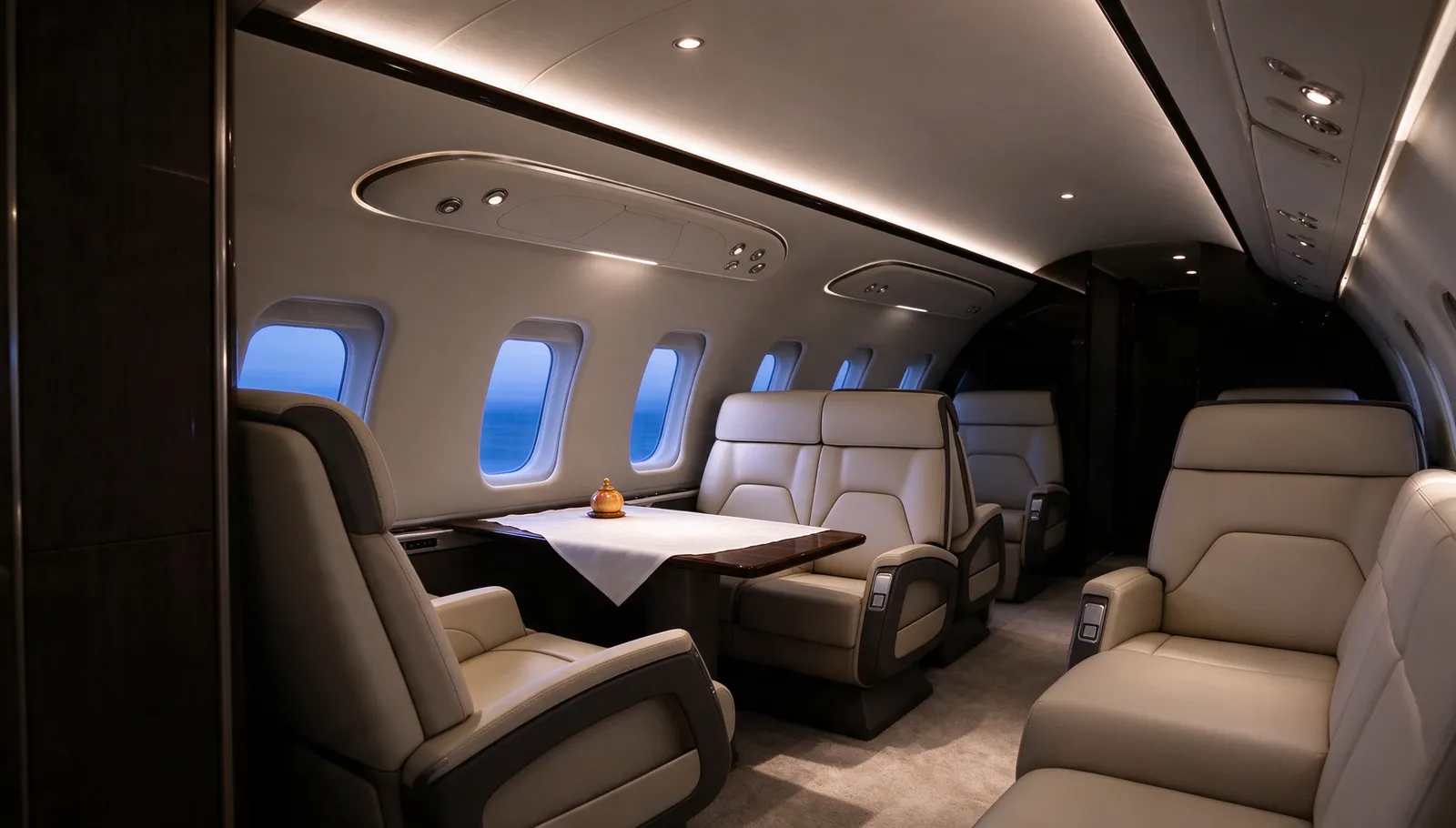
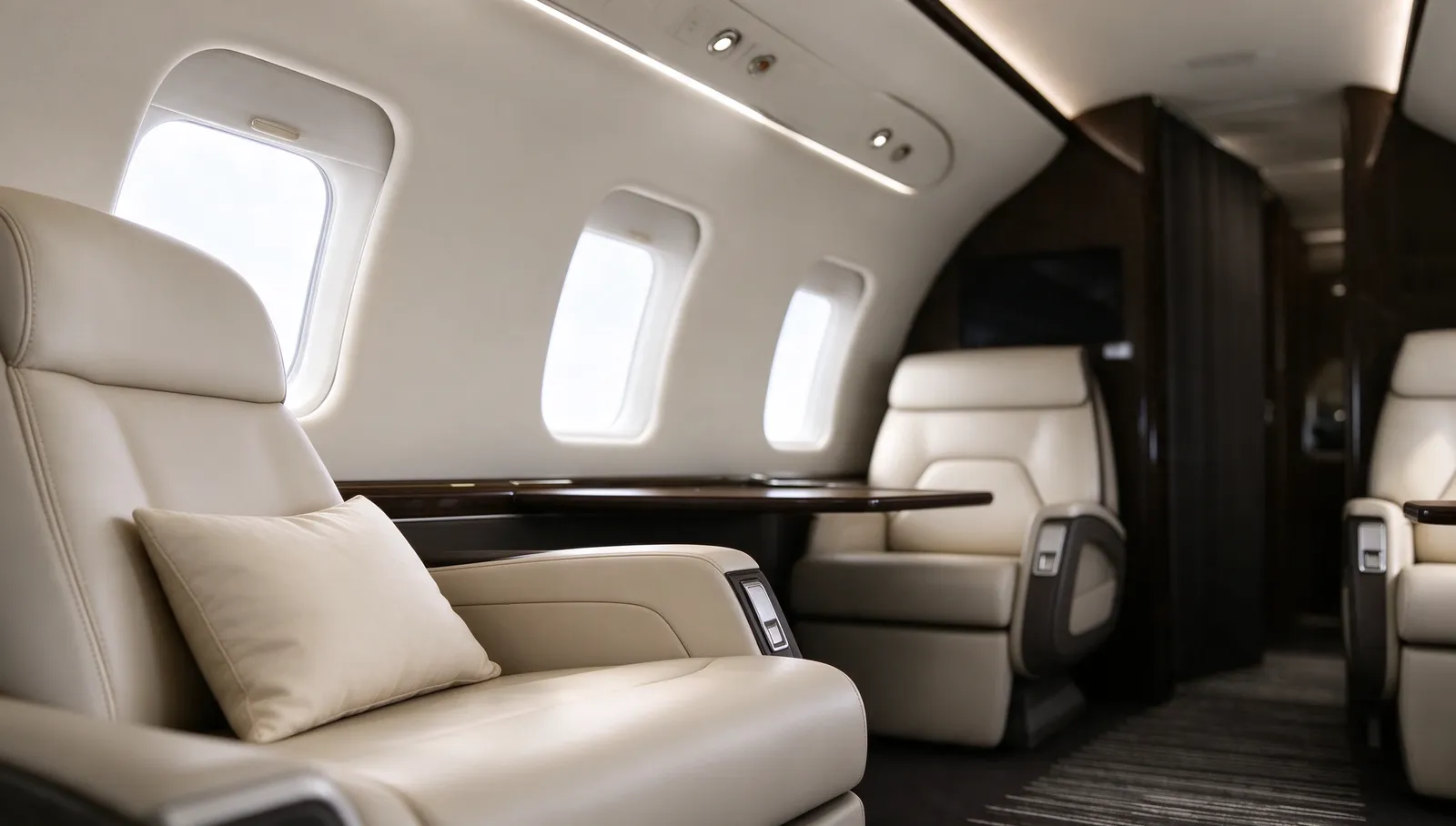
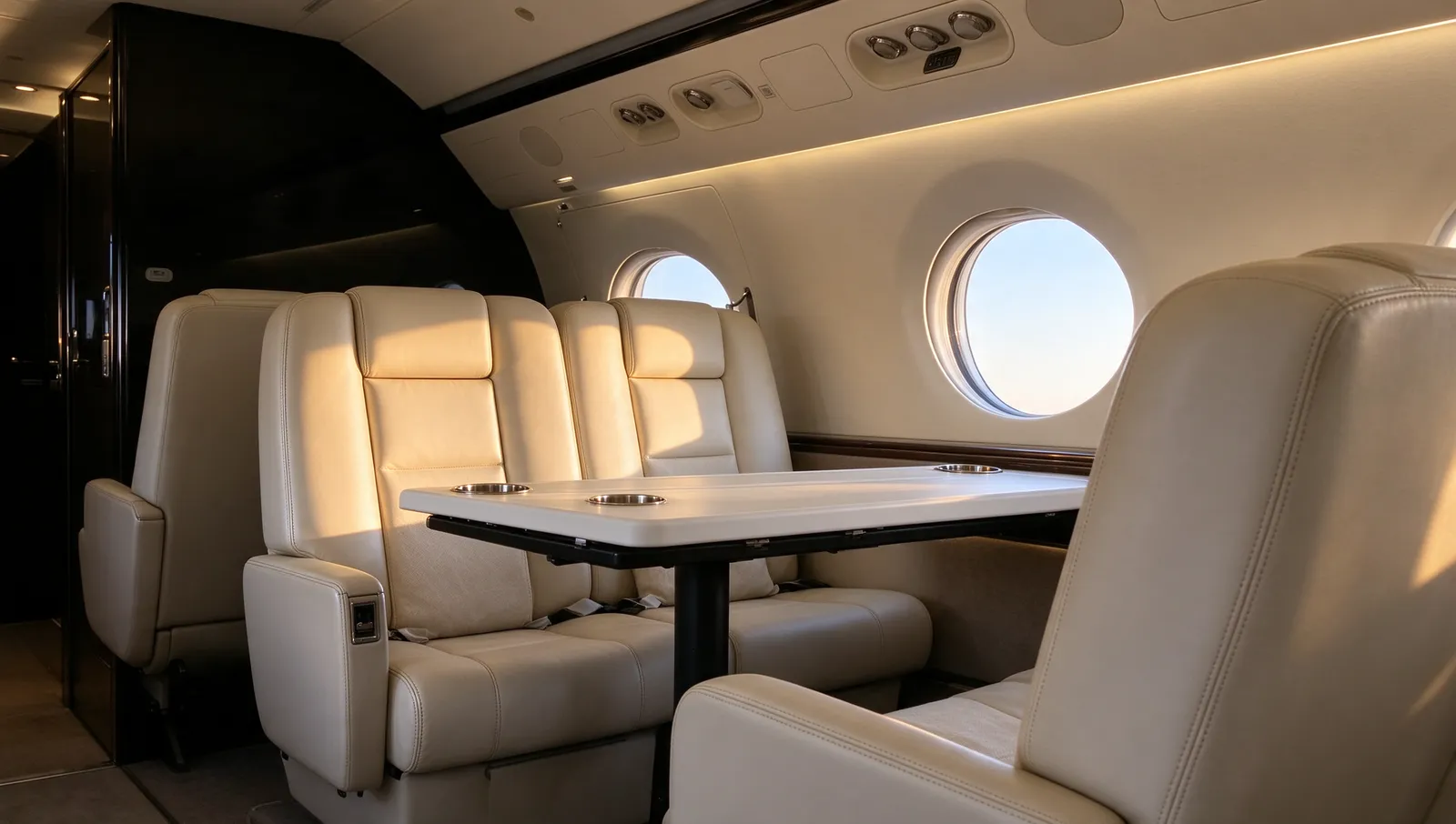
Figures are published manufacturer data, shown for illustration only. Images are generated for this concept and show the Challenger 650 type, not a specific aircraft. Bombardier and Challenger 650 are trademarks of their owner, used only to identify the aircraft.