Midsize Jet
Bombardier Learjet 60XR

Range
2,405 NM
Cruise speed
446 kts
Seats
7
History
Bombardier announced the Learjet 60 in October 1990, soon after it bought Learjet, and the aircraft first flew that same month. FAA certification followed in January 1993. The 60 offered noticeably more capacity than the earlier Learjet 55. In 2005 Bombardier launched the XR upgrade, which was certified and entered delivery in 2007. Production ended in 2013 after 114 aircraft, and the 60XR was the last development of the line.
The XR brought a Rockwell Collins Pro Line 21 flight deck with four large LCD screens, electronic charts, new AHRS and FMS units and optional XM radio weather. In the cabin, owners could choose from five floor plans, with LED lighting, better insulation and a new cabin management system. Upgraded engines completed the package, along with disc brakes using three rotors and rated to last 450 to 600 landings.
Technical Specifications
General information
| Model name | Learjet 60XR |
|---|---|
| Manufacturer | Bombardier |
| Aircraft category | midsize jet |
| ICAO Designator | LJ60 |
| Start/End of Production | 2007 - 2013 |
| Number of pilot(s) | 2 |
Performances
| Range (with IFR reserves) | 2405 NM (4454 km) |
|---|---|
| Ferry range | 2478 NM (4589 km) |
| Cruise speed | 446 kts (826 km/h) |
| Max Operating Speed – VMO | 330 KIAS |
| Max Mach Operating Speed - MMO | Mach 0.81 |
| Long-Range Cruise Speed - LRC | 423 KTAS |
| Approach Speed | 139 kts |
| Takeoff Distance | 1804 m |
| Average Landing Distance | 972 m |
| Rate of Climb | 6000 ft/min |
| Service Ceiling | 51000 ft |
| Thrust | 4600 lbf |
Aircraft technology
| Engine type | Turbofan |
|---|---|
| Engine(s) | 2 x Pratt & Whitney Canada PW305A |
| Avionics | Rockwell Collins Pro Line 21 |
Dimensions and capacity
| Aircraft length | 17.88 m |
|---|---|
| Aircraft height | 4.47 m |
| Wing span | 13.34 m |
| Cabin height | 1.75 m (5.75 ft) |
| Cabin length | 5.39 m (17.67 ft) |
| Cabin width | 1.78 m (5.83 ft) |
| Baggage volume | 1.67 m3 |
| Seats (standard config) | 7 |
| Seats (max) | 9 |
| Suitcases | 6 |
| Carry-on luggage | 6 |
| Maximum payload | 952 kg |
| Maximum TakeOff Weight - MTOW | 10659 kg |
| Maximum Landing Weight - MLW | 8845 kg |
FAQ
Learjet 60XR or Learjet 45XR: what is the difference?
The 60XR flies further, with 2,405 nautical miles (4,454 km) of range against about 2,000 nautical miles (3,704 km) for the 45XR. The 45XR has the longer cabin, at 6.02 metres against 5.39 metres, and seats 8 in standard form, where the 60XR seats 7.
How far can a Learjet 60XR fly?
Its range with IFR reserves is 2,405 nautical miles, or 4,454 km. A small group can fly Paris to Cairo or New York to Denver without stopping, and the aircraft suits regional and medium-haul trips where speed and efficiency count.
What is the 60XR cabin like?
The cabin is roomier in both length and width than that of the original Learjet 60. It has club seats and fold-out tables, and soundproofing keeps it quiet. A galley and an enclosed lavatory make it practical for flights of several hours. Seven passengers is the standard layout, with room for up to nine.
Learjet 60XR or Gulfstream G150: which should I choose?
The Learjet climbs faster, at up to 6,000 feet per minute, which suits time-sensitive flights, and it can cruise higher, at up to 51,000 feet against 45,000. The G150 cruises faster at 475 knots against 446, flies further at 2,988 nautical miles against 2,405, and has a slightly wider cabin with lower operating costs.
Gallery
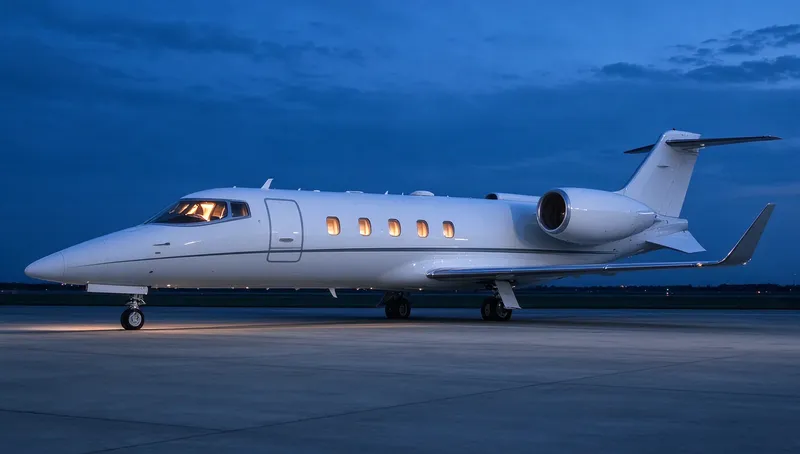
Figures are published manufacturer data, shown for illustration only. Images are generated for this concept and show the Learjet 60XR type, not a specific aircraft. Bombardier and Learjet 60XR are trademarks of their owner, used only to identify the aircraft.