Light Jet
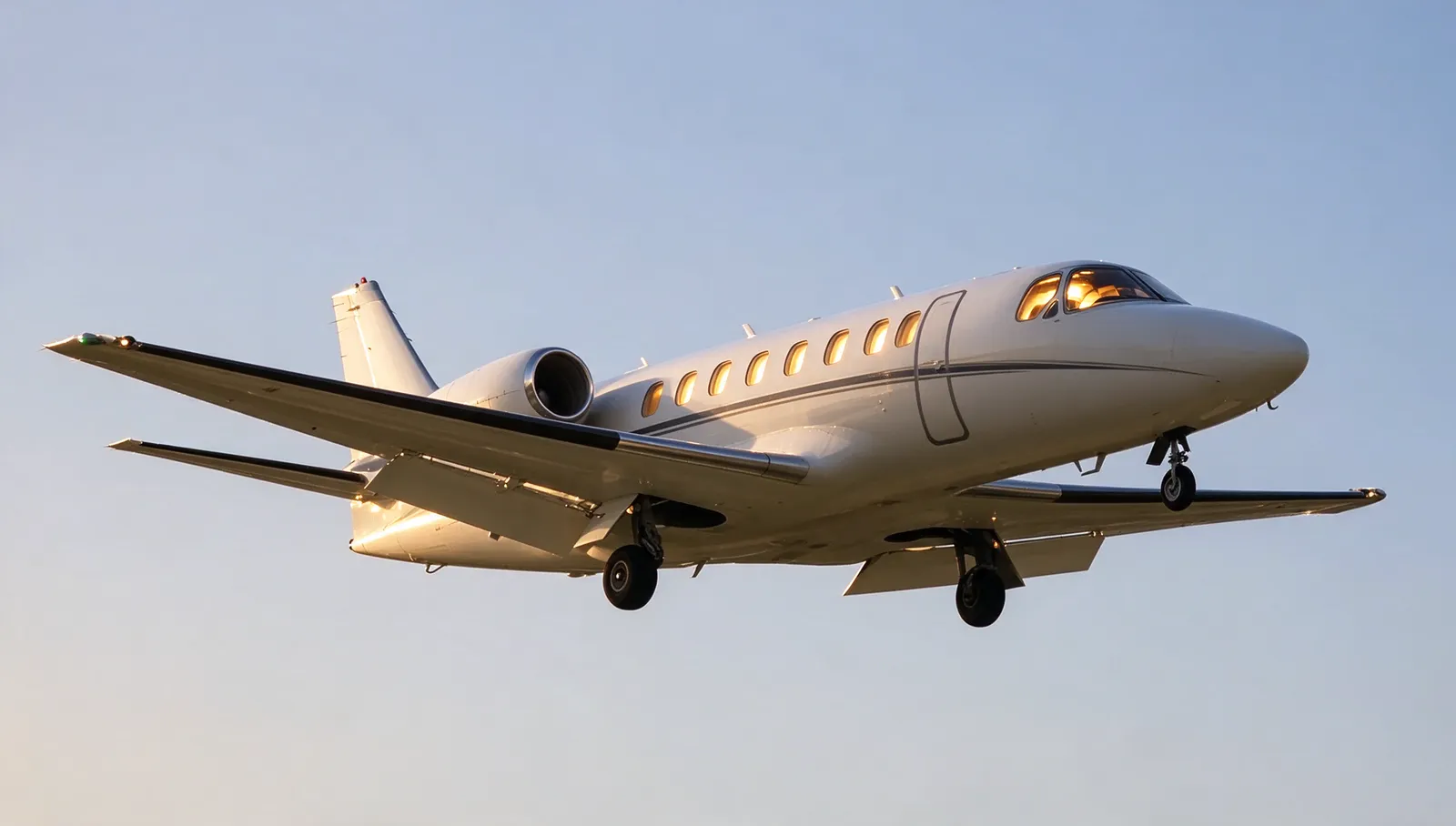
Cessna Citation Bravo
Range
1,495 NM
Cruise speed
399 kts
Seats
7
History
The Citation Bravo replaced the Citation S/II series, adding a longer fuselage, new avionics and stronger engines. It first flew on 25 April 1995, received certification in August 1996 and reached its first customers in February 1997. Cessna developed it in response to demand for better performance than the earlier aircraft could offer.
Two Pratt & Whitney Canada PW530A turbofans give the Bravo considerably more thrust than earlier Citation II variants. Together with trailing-link landing gear and a Honeywell Primus 1000 avionics suite, they allowed operators to use the Bravo for a wider range of missions, with more flexibility in payload and range than its predecessors offered.
Cessna built 337 Bravos before production ended in late 2006, after almost ten years. The aircraft links the earlier Citation II series with the newer CJ models that followed, and it helped Cessna hold its position as a leading business jet manufacturer during that period.
Technical Specifications
General information
| Model name | Citation Bravo |
|---|---|
| Manufacturer | Cessna |
| Aircraft category | light jet |
| ICAO Designator | C550 |
| Start/End of Production | 1996 - 2006 |
| Number of pilot(s) | 2 |
Performances
| Range (with IFR reserves) | 1495 NM (2769 km) |
|---|---|
| Ferry range | 2000 NM (3704 km) |
| Cruise speed | 399 kts (739 km/h) |
| Max Operating Speed – VMO | 275 KIAS |
| Max Mach Operating Speed - MMO | Mach 0.7 |
| Long-Range Cruise Speed - LRC | 342 KTAS |
| Approach Speed | 110 kts |
| Takeoff Distance | 1097 m |
| Average Landing Distance | 767 m |
| Rate of Climb | 3196 ft/min |
| Service Ceiling | 45000 ft |
| Thrust | 2887 lbf |
Aircraft technology
| Engine type | Turbofan |
|---|---|
| Engine(s) | 2 x Pratt & Whitney Canada PW530A |
| Avionics | Honeywell Primus 1000 |
Dimensions and capacity
| Aircraft length | 14.4 m |
|---|---|
| Aircraft height | 4.6 m |
| Wing span | 15.8 m |
| Cabin height | 1.45 m (4.75 ft) |
| Cabin length | 4.88 m (16.0 ft) |
| Cabin width | 1.45 m (4.75 ft) |
| Baggage volume | 2.07 m3 |
| Seats (standard config) | 7 |
| Seats (max) | 8 |
| Suitcases | 4 |
| Carry-on luggage | 6 |
| Maximum payload | 816 kg |
| Maximum TakeOff Weight - MTOW | 6713 kg |
FAQ
Citation Bravo or Phenom 300: which should I choose?
The Phenom 300 is the newer aircraft. It flies further, 2,010 nautical miles against 1,495 for the Bravo, is quicker in the cruise and its cabin is more modern. Clients choose the Bravo for its long record of reliability and keen charter rates, and for the short-field ability that lets it use smaller regional airports.
How far can a Citation Bravo fly on a charter?
Its range with IFR reserves is 1,495 nautical miles (2,769 km). The real distance on a given day depends on payload and weather, as well as the routing and cruise altitude flown. In good conditions that allows direct flights such as Geneva to Madrid, Paris to Stockholm or London to Athens.
Which airports can a Citation Bravo use?
Its short-field ability and steep-approach certification let it use airports with short runways or demanding approach paths, London City among them. Take-off needs about 1,097 m and landing about 767 m. That gives direct access to regional cities and holiday destinations that larger aircraft often cannot serve.
Where does the Bravo sit in the Citation range?
Cessna produced the Bravo from 1996 to 2006 to improve on the Citation II, and it bridges the earlier Citations and the newer CJ series that replaced it. Three things distinguish it: the stronger PW530A engines, the Honeywell Primus 1000 avionics suite and its trailing-link landing gear. The gear softens landings and helps on shorter runways.
Gallery
Figures are published manufacturer data, shown for illustration only. Images are generated for this concept and show the Citation Bravo type, not a specific aircraft. Cessna and Citation Bravo are trademarks of their owner, used only to identify the aircraft.