Light Jet
Cessna Citation CJ1
Range
1,121 NM
Cruise speed
377 kts
Seats
5
History
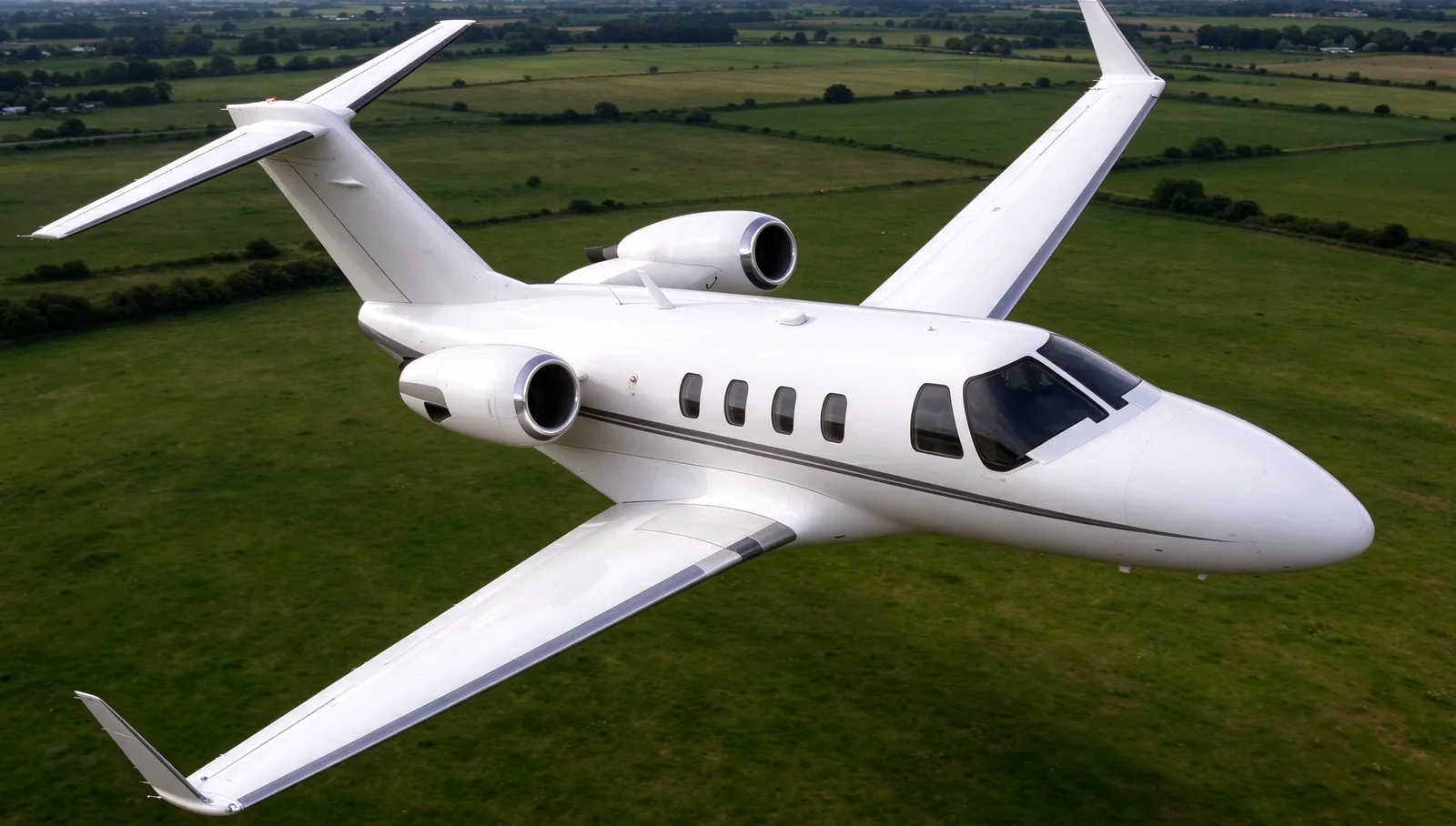
The CitationJet, Cessna's Model 525, was developed to replace the Citation I after rising prices for its Pratt & Whitney engines left that aircraft uncompetitive. Although it reused the forward fuselage in modified form, much of the CitationJet was new, including a laminar-flow wing and a T-tail. A fairing covers part of the wing, and to cut drag the engines are mounted higher on the tail, while composites save weight on parts that carry no load, such as the nose.
The fuselage is 27 cm shorter than the Citation I's, and a lowered centre aisle gives more headroom in the cabin. The first CitationJet flew on 29 April 1991, powered by two newly developed Williams FJ44-1A turbofans, an engine later chosen by other manufacturers, including Pilatus for the PC-24. The aircraft was designed from the start to be flown by a single pilot.
The Citation CJ1 is a development of the original CitationJet, still carrying the Model 525 designation, with improved avionics and a higher maximum take-off weight. Built from 2000 to 2005, it flies with Rockwell Collins Pro Line 21 avionics, and its electronic flight instruments ease the pilot's workload, with traffic collision avoidance adding a layer of safety.
The 525 family has been a strong seller. By June 2017 Cessna had delivered 2,000 CitationJet variants, more than a third of all Citations built, and the fleet had flown 5 million hours. The design continues today in the M2 Gen2, CJ3+ and CJ4 Gen2, while the original CitationJet and CJ1 remain a reliable, low-cost way to fly privately on short trips.
Technical Specifications
General information
| Model name | Citation CJ1 |
|---|---|
| Manufacturer | Cessna |
| Aircraft category | light jet |
| ICAO Designator | C525 |
| Start/End of Production | 2000 - 2005 |
| Number of pilot(s) | 1-2 |
Performances
| Range (with IFR reserves) | 1121 NM (2076 km) |
|---|---|
| Ferry range | 1290 NM (2389 km) |
| Cruise speed | 377 kts (698 km/h) |
| Max Operating Speed – VMO | 263 KIAS |
| Max Mach Operating Speed - MMO | Mach 0.7 |
| Long-Range Cruise Speed - LRC | 329 KTAS |
| Approach Speed | 109 kts |
| Takeoff Distance | 939 m |
| Average Landing Distance | 758 m |
| Rate of Climb | 3250 ft/min |
| Service Ceiling | 41000 ft |
| Thrust | 1900 lbf |
Aircraft technology
| Engine type | Turbofan |
|---|---|
| Engine(s) | 2 x Williams FJ44-1A |
| Avionics | Rockwell Collins Pro Line 21 |
Dimensions and capacity
| Aircraft length | 13 m |
|---|---|
| Aircraft height | 4.2 m |
| Wing span | 14.3 m |
| Cabin height | 1.46 m (4.8 ft) |
| Cabin length | 3.35 m (11.0 ft) |
| Cabin width | 1.46 m (4.8 ft) |
| Baggage volume | 1.56 m3 |
| Seats (standard config) | 5 |
| Seats (max) | 7 |
| Suitcases | 3 |
| Carry-on luggage | 4 |
| Maximum payload | 694 kg |
| Maximum TakeOff Weight - MTOW | 4808 kg |
| Fuel capacity | 1811 L |
Advantages & Disadvantages
Advantages
- Easy to find: Few light business jets are as common worldwide as the CitationJet, so there is usually an aircraft available, often at a good price, which matters most when you need to fly at short notice.
- Built for short hops: With a range of 1,121 nm (2,076 km), the CJ1 is designed for shorter distances, and its light, aerodynamic airframe burns less fuel than larger jets. It suits flights within Europe particularly well.
- A best-seller: Its affordability, reliability and efficiency have made the CitationJet the top-selling light business jet, and that popularity also makes it good value for business and leisure charters.
- Low running costs: The FJ44 engines are notably fuel-efficient, and decades of development within the CitationJet family have made the 525 a technically mature aircraft, which keeps charter costs down.
- A proven design: Cessna has built the 525 family since 1993, and it has a long record of reliability and safety. Repeated refinements over that time mean the CJ1 benefits from a thoroughly tested design.
Disadvantages
- Shorter range: The CJ1 cannot fly as far as many other jets in its class, so more distant destinations need a fuel stop. The newer CJ2+, for example, flies about 500 km further.
- Compact cabin: Next to larger business jets, the CJ1 offers fewer comforts for meetings, focused work or rest. The cabin is small and can feel tight with every seat taken, and there is little room for storage.
FAQ
Which airports can a CitationJet or CJ1 reach?
The CJ1 needs only 939 m of runway for take-off, which opens up smaller airports closer to resorts and business districts and saves time on the ground. London City Airport, which few private jets are certified to use, is open to it, and so are Lugano and St. Moritz in Switzerland and Nice on the Côte d'Azur.
What are the sales figures for the CitationJet and CJ1?
Cessna sold 443 aircraft of the series between 1996 and 2005, and no independent figures exist for 1993 to 1995. The best year was 1998, with 64 deliveries, a total beaten within the CJ series only once, when 88 CJ3s were delivered in 2008. That large fleet makes the type easy to source for charter.
How much does it cost to charter a CJ1?
There is no set rate. The price of a CJ1 charter depends on the route, your travel dates, where the nearest suitable aircraft is based and the operator flying it. Our advisors price each trip individually and send you a quote for the exact itinerary you request.
Is the CitationJet or CJ1 certified for a single pilot?
Yes. Both the original CitationJet and the CJ1 are certified for single-pilot flight, and a co-pilot can fly alongside if the operator chooses. The aircraft was designed from the outset to be easy for one pilot to manage, helped by its electronic flight instrument system.
What are the differences between the CJ1 and the Citation CJ2?
The CJ2 grew out of the CJ1 and is a little bigger and quicker. Its cabin is 84 cm longer and its wingspan almost 89 cm wider, and it seats six against the CJ1's five. Newer engines give it a higher cruise speed and better efficiency, and its range rises to 1,330 nm (2,463 km) from the CJ1's 1,121 nm, which suits longer European routes and slightly bigger groups.
Does the CitationJet have a toilet on board?
Yes, there is a toilet, but it is not fully separated from the cabin and is best kept for occasional use. On the short sectors the CJ1 usually flies, that is rarely a concern, but passengers who want a private washroom should consider a larger aircraft.
What is the CJ1's range?
With IFR reserves the CJ1 covers 1,121 nm (2,076 km), subject to payload, weather and routing. That is enough for non-stop flights like Munich to Brussels, Paris to Geneva or London to Milan. Transatlantic flights are possible with stops, but they are uncommon, and faster, roomier aircraft suit longer trips better.
CJ1 or Citation Mustang: which should I choose?
The CJ1 is the larger of the two, seating five in a standard layout against four in the Mustang. The Mustang flies slightly further, 1,167 nm against the CJ1's 1,121 nm, and is usually the cheaper charter. The CJ1 costs a little more but gives extra cabin space and payload, so it makes sense when comfort or baggage matters.
Gallery
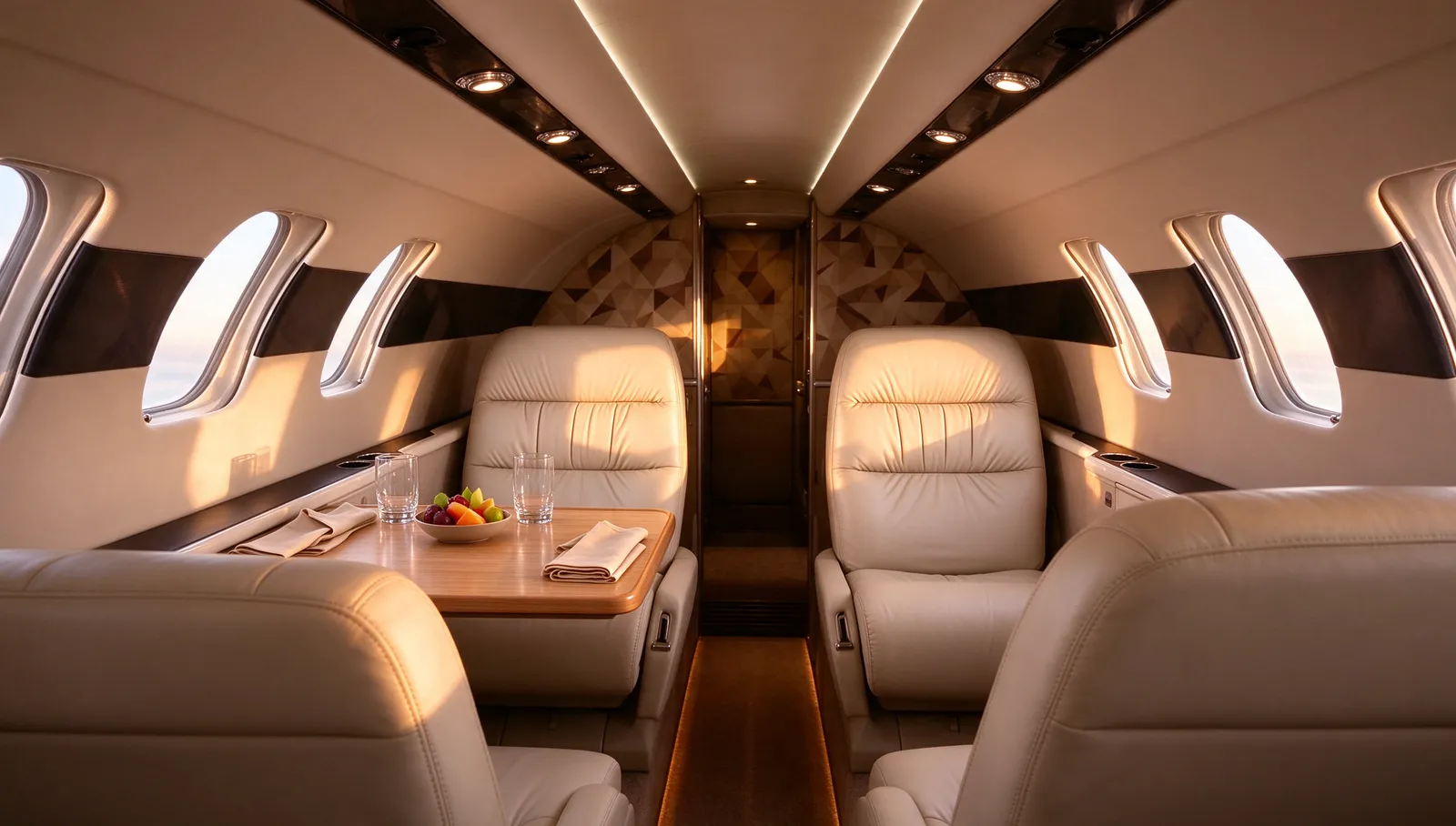
Figures are published manufacturer data, shown for illustration only. Images are generated for this concept and show the Citation CJ1 type, not a specific aircraft. Cessna and Citation CJ1 are trademarks of their owner, used only to identify the aircraft.