Light Jet
Cessna Citation V
Range
1,960 NM
Cruise speed
425 kts
Seats
8
History
Cessna created the Citation V, also known as the Model 560, by stretching the Citation S/II to make room for more passengers. The prototype flew for the first time in August 1987, and FAA certification came on 9 December 1988. Production ran from 1989 to 1994, and in those five years Cessna built 774 aircraft, a total that places the Citation V among the most successful business jets of its time.
Cessna followed it with the Citation V Ultra, introduced in September 1993 and certified by the FAA in June 1994. The Ultra's Pratt & Whitney JT15D-5D engines were redesigned with new compressors, new turbines on the high pressure side and fan discs machined from solid metal. They produced 3,045 lb of thrust each and were lighter and more economical than before.
Next came the Citation Ultra Encore, which Cessna presented at the NBAA convention in 1998. It switched to Pratt & Whitney PW535 engines and gained certification in April 2000. Each of these steps refined a design that operators already trusted, and that steady improvement helps explain why the Citation family became so common in business aviation.
Technical Specifications
General information
| Model name | Citation V |
|---|---|
| Manufacturer | Cessna |
| Aircraft category | light jet |
| ICAO Designator | C560 |
| Start/End of Production | 1989 - 1994 |
| Number of pilot(s) | 2 |
Performances
| Range (with IFR reserves) | 1960 NM (3630 km) |
|---|---|
| Ferry range | 2090 NM (3871 km) |
| Cruise speed | 425 kts (787 km/h) |
| Max Operating Speed – VMO | 292 KIAS |
| Max Mach Operating Speed - MMO | Mach 0.76 |
| Long-Range Cruise Speed - LRC | 350 KTAS |
| Approach Speed | 103 kts |
| Takeoff Distance | 970 m |
| Average Landing Distance | 854 m |
| Rate of Climb | 3460 ft/min |
| Service Ceiling | 45000 ft |
| Thrust | 2900 lbf |
Aircraft technology
| Engine type | Turbofan |
|---|---|
| Engine(s) | 2 |
| Avionics | Collins EFIS-84 |
Dimensions and capacity
| Aircraft length | 14.9 m |
|---|---|
| Aircraft height | 4.5 m |
| Wing span | 15.9 m |
| Cabin height | 1.46 m (4.80 ft) |
| Cabin length | 5.28 m (17.33 ft) |
| Cabin width | 1.47 m (4.83 ft) |
| Baggage volume | 0.68 m3 |
| Seats (standard config) | 8 |
| Seats (max) | 11 |
| Suitcases | 6 |
| Carry-on luggage | 6 |
| Maximum payload | 1000 kg |
| Maximum TakeOff Weight - MTOW | 7200 kg |
| Maximum Landing Weight - MLW | 6895 kg |
| Fuel capacity | 3680 L |
FAQ
Should I choose a Citation V or a Citation Encore?
The Encore came later and uses Pratt & Whitney PW535 engines, which burn less fuel and give a stronger climb. It also has newer avionics and lower operating costs. Cruise speeds are close, at 426 and 425 knots, and both carry eight passengers in similar cabins. On published figures the Citation V has the longer range, at 1,960 nm against 1,673 nm.
Is the Citation V approved for steep approaches?
No. The Citation V does not have the steep approach certification that airports such as London City require. Later Citations, including the CJ2 and more recent models, do have it. If your trip involves an airport with a demanding approach, our advisors will suggest a newer Cessna instead.
What is it like to fly in a Citation V?
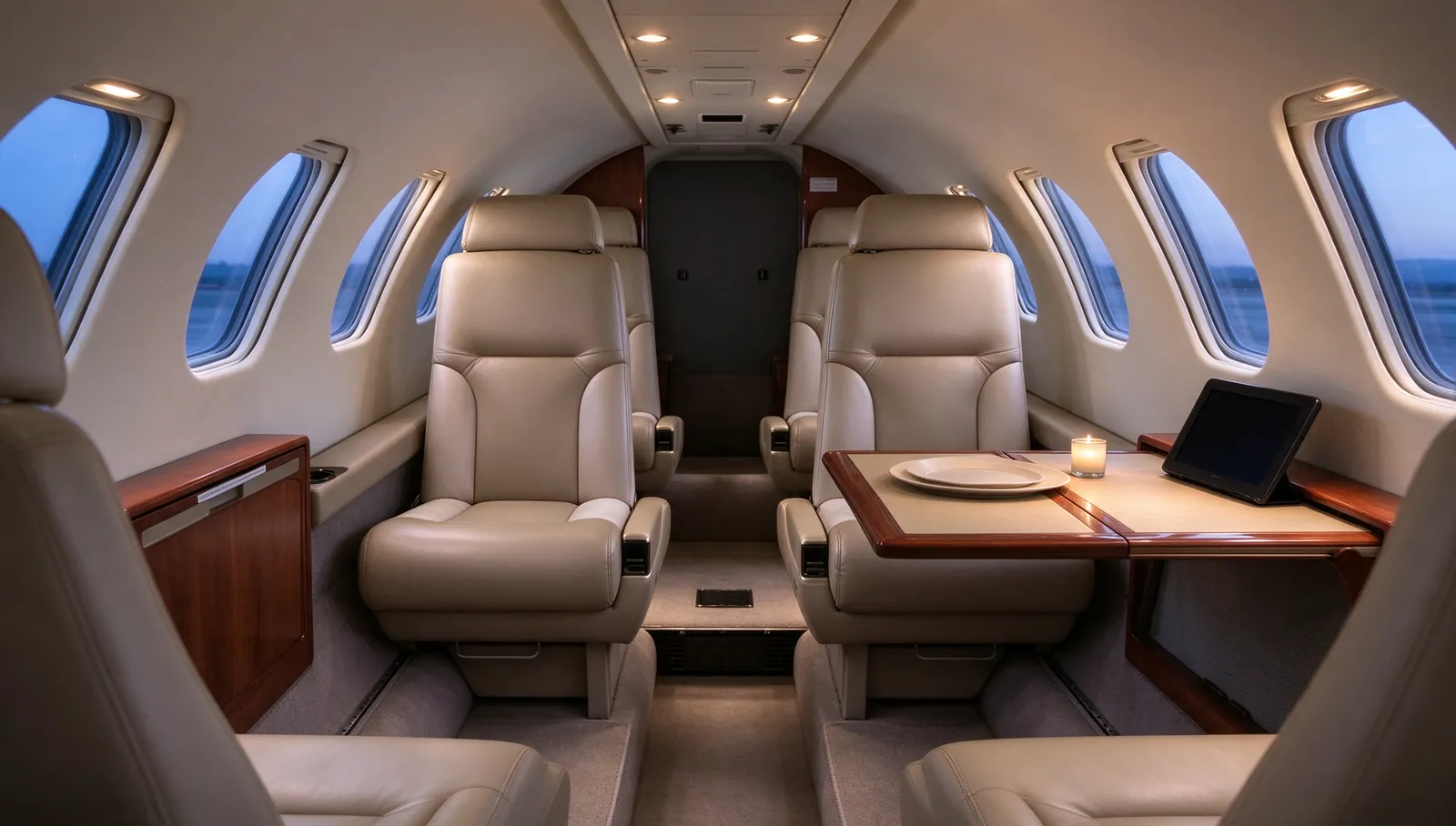
The cabin is set up for eight passengers as standard, and some layouts take up to 11. It measures 5.28 m long and 1.47 m wide, with wide seats and a quiet atmosphere. Most aircraft have a club group with forward-facing chairs, a small galley, an enclosed washroom and a rear hold for several suitcases.
How far can a Citation V fly?
With IFR reserves, the Citation V covers up to 1,960 nm (3,630 km), depending on payload and weather. That makes nonstop routes such as New York to Miami or London to Milan straightforward, and it gives the aircraft longer legs than many light jets of its era.
Should I choose a Citation V or a Citation VII?
The Citation VII belongs to the midsize class, with 2,220 nm of range and a 460 knot cruise. The Citation V is a light jet that cruises at 425 knots and covers shorter distances. Clients usually pick the VII for extra cabin space and speed, and the V for efficient regional flights.
Gallery
Figures are published manufacturer data, shown for illustration only. Images are generated for this concept and show the Citation V type, not a specific aircraft. Cessna and Citation V are trademarks of their owner, used only to identify the aircraft.