Large Jet
Dassault Falcon 2000
Range
3,052 NM
Cruise speed
479 kts
Seats
8-12
History
The Falcon 2000 started life in 1989 as the Falcon X, a project to add a new model to Dassault's range with better performance and modern systems. It took its final name before entering service. The first flight came on 4 March 1993, certification followed in 1994 and production began in 1995, continuing until 2007.
The design paired two engines with a supercritical wing and Dassault's build quality, aimed at operators who wanted long range without high running costs. It became the base for every later variant, from the 2000EX and 2000LX to the 2000S and 2000LXS, which makes the original aircraft the starting point for one of the most successful families in business aviation.
Technical Specifications
General information
| Model name | Falcon 2000 |
|---|---|
| Manufacturer | Dassault Aviation |
| Aircraft category | large jet |
| ICAO Designator | F2TH |
| Start/End of Production | 1995 - 2007 |
| Number of pilot(s) | 2 |
Performances
| Range (with IFR reserves) | 3052 NM (5652 km) |
|---|---|
| Ferry range | 3130 NM (5797 km) |
| Cruise speed | 479 kts (887 km/h) |
| Max Operating Speed – VMO | 370 KIAS |
| Max Mach Operating Speed - MMO | Mach 0.87 |
| Long-Range Cruise Speed - LRC | 417 KTAS |
| Approach Speed | 113 kts |
| Takeoff Distance | 1640 m |
| Average Landing Distance | 792 m |
| Rate of Climb | 3700 ft/min |
| Service Ceiling | 47000 ft |
| Thrust | 5918 lbf |
Aircraft technology
| Engine type | Turbofan |
|---|---|
| Engine(s) | 2 x CFE738-1-1B |
| Avionics | Collins Pro Line 4 |
Dimensions and capacity
| Aircraft length | 20.23 m |
|---|---|
| Aircraft height | 7.11 m |
| Wing span | 21.38 m |
| Cabin height | 1.9 m (6.2 ft) |
| Cabin length | 9.8 m (32.2 ft) |
| Cabin width | 2.34 m (7.67 ft) |
| Baggage volume | 3.79 m3 |
| Seats (standard config) | 8-12 |
| Seats (max) | 19 |
| Suitcases | 12 |
| Carry-on luggage | 10 |
| Maximum TakeOff Weight - MTOW | 19414 kg |
| Maximum Landing Weight - MLW | 17826 kg |
| Fuel capacity | 9446 L |
FAQ
Falcon 2000 or Falcon 900: which suits my trip?
The 2000 has two engines, 3,052 nautical miles (5,652 km) of range and a 479-knot cruise, and it was designed as a smaller and more economical partner to the three-engine 900. The latest 900LX flies 4,750 nautical miles at 474 knots. Choose the 2000 for regional and medium-haul trips, and the 900 when you need more range, a third engine or a bigger cabin.
How does it compare with the Gulfstream G550?
The G550 is a much longer-range aircraft, quoted at 6,750 nautical miles (12,501 km) with a 488-knot cruise, and it typically carries 14 to 16 passengers. It is the choice for nonstop intercontinental flights. The Falcon 2000 covers 3,052 nautical miles and costs less to operate, which makes it the sensible option for regional trips and shorter intercontinental legs.
What is the Falcon 2000's nonstop range?
Range with IFR reserves is 5,652 km (3,052 nautical miles). Istanbul from London and Dubai from Paris are both within a single flight. The later 2000EX and 2000LX fly further, but the original model remains a popular choice for regional flights and medium-haul intercontinental trips.
Is the Falcon 2000 still flown on charter?
Yes. Production of the original model ended in 2007, but it is still flown by charter operators around the world. A wide cabin, 3,052 nautical miles of range and access to shorter airports keep it in demand, and many aircraft now carry updated avionics and Wi-Fi.
Where does the original Falcon 2000 sit in its family?
It was the first of the line, introduced in the mid-1990s as a widebody twin with enough range for regional work and some transcontinental flights. The EX, LX, S and LXS versions that followed all grew from it, each adding range, refined aerodynamics or better runway performance.
Gallery
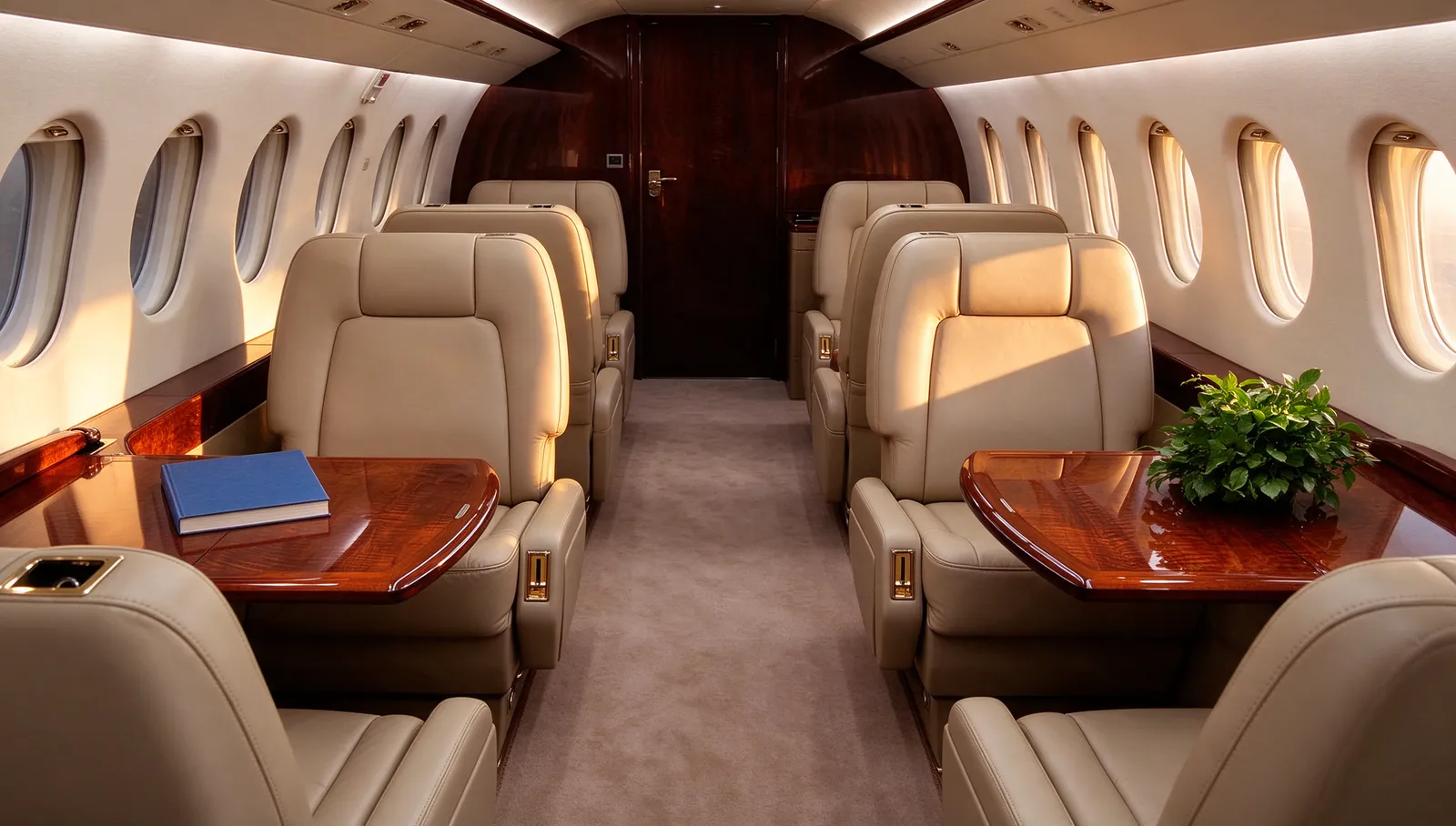
Figures are published manufacturer data, shown for illustration only. Images are generated for this concept and show the Falcon 2000 type, not a specific aircraft. Dassault Aviation and Falcon 2000 are trademarks of their owner, used only to identify the aircraft.