Super Large Jet
Dassault Falcon 900B
Range
4,000 NM
Cruise speed
474 kts
Seats
12
History
Dassault built the Falcon 900B from 1991 to 2000 as the first major update to the original Falcon 900. Operators had asked for more power and lower fuel burn, and the 900B answered with three Honeywell TFE731-5BR turbofans that produce more thrust and use fuel more economically than the earlier engines. That gain translated into longer range, now 4,000 nautical miles with IFR reserves.
Dassault kept the three-engine layout. If one engine fails, two remain, and that redundancy allowed the 900B to serve airports and missions that were harder for twin-engine competitors to take on. The extra range also gave operators more flexibility in how they planned routes and where they could fly without a stop.
Between the original Falcon 900 and the 900B, 160 aircraft were delivered. The improvements made on the 900B became the starting point for later versions, including the 900C and the 900DX, which kept the same 4,000 nautical mile range while introducing newer avionics. Dassault has followed this pattern of steady refinement throughout the Falcon 900 family.
Technical Specifications
General information
| Model name | Falcon 900B |
|---|---|
| Manufacturer | Dassault Aviation |
| Aircraft category | super large jet |
| ICAO Designator | F900 |
| Start/End of Production | 1991 - 2000 |
| Number of pilot(s) | 2 |
Performances
| Range (with IFR reserves) | 4000 NM (7408 km) |
|---|---|
| Ferry range | 4600 NM (8519 km) |
| Cruise speed | 474 kts (878 km/h) |
| Max Operating Speed – VMO | 370 KIAS |
| Max Mach Operating Speed - MMO | Mach 0.87 |
| Long-Range Cruise Speed - LRC | 426 KTAS |
| Approach Speed | 85 kts |
| Takeoff Distance | 1585 m |
| Average Landing Distance | 671 m |
| Service Ceiling | 51000 ft |
| Thrust | 4750 lbf |
Aircraft technology
| Engine type | Turbofan |
|---|---|
| Engine(s) | 3 x Honeywell TFE731-5BR |
| Avionics | Honeywell Primus Epic |
Dimensions and capacity
| Aircraft length | 20.21 m |
|---|---|
| Aircraft height | 7.55 m |
| Wing span | 19.33 m |
| Cabin height | 1.9 m (6.2 ft) |
| Cabin length | 10.11 m (33.17 ft) |
| Cabin width | 2.3 m (7.7 ft) |
| Baggage volume | 3.6 m3 |
| Seats (standard config) | 12 |
| Seats (max) | 19 |
| Suitcases | 12 |
| Carry-on luggage | 10 |
| Maximum TakeOff Weight - MTOW | 20640 kg |
| Maximum Landing Weight - MLW | 19050 kg |
| Fuel capacity | 10862 L |
FAQ
What does the third engine add on a Falcon 900B?
If one engine fails, the aircraft still has two running, which keeps climb performance stronger than a twin left with a single engine. A trijet also falls outside the ETOPS limits written for twin-engine aircraft, which can matter on remote oceanic routes and around airports with difficult terrain or weather, where those rules would restrict a twin.
What separates the 900B from the later 900C and 900DX?
All three have the same range of 4,000 nautical miles. At 878 km/h, the 900B's cruise speed is a little below the 900C, at 885 km/h, and the 900DX, at 893 km/h. The 900C took on avionics developed for the 900EX, and the 900DX brought the Honeywell Primus Epic EASy flight deck. The 900B was built between 1991 and 2000, the 900C between 2000 and 2005, and the 900DX between 2005 and 2010.
How many passengers fit in a Falcon 900B?
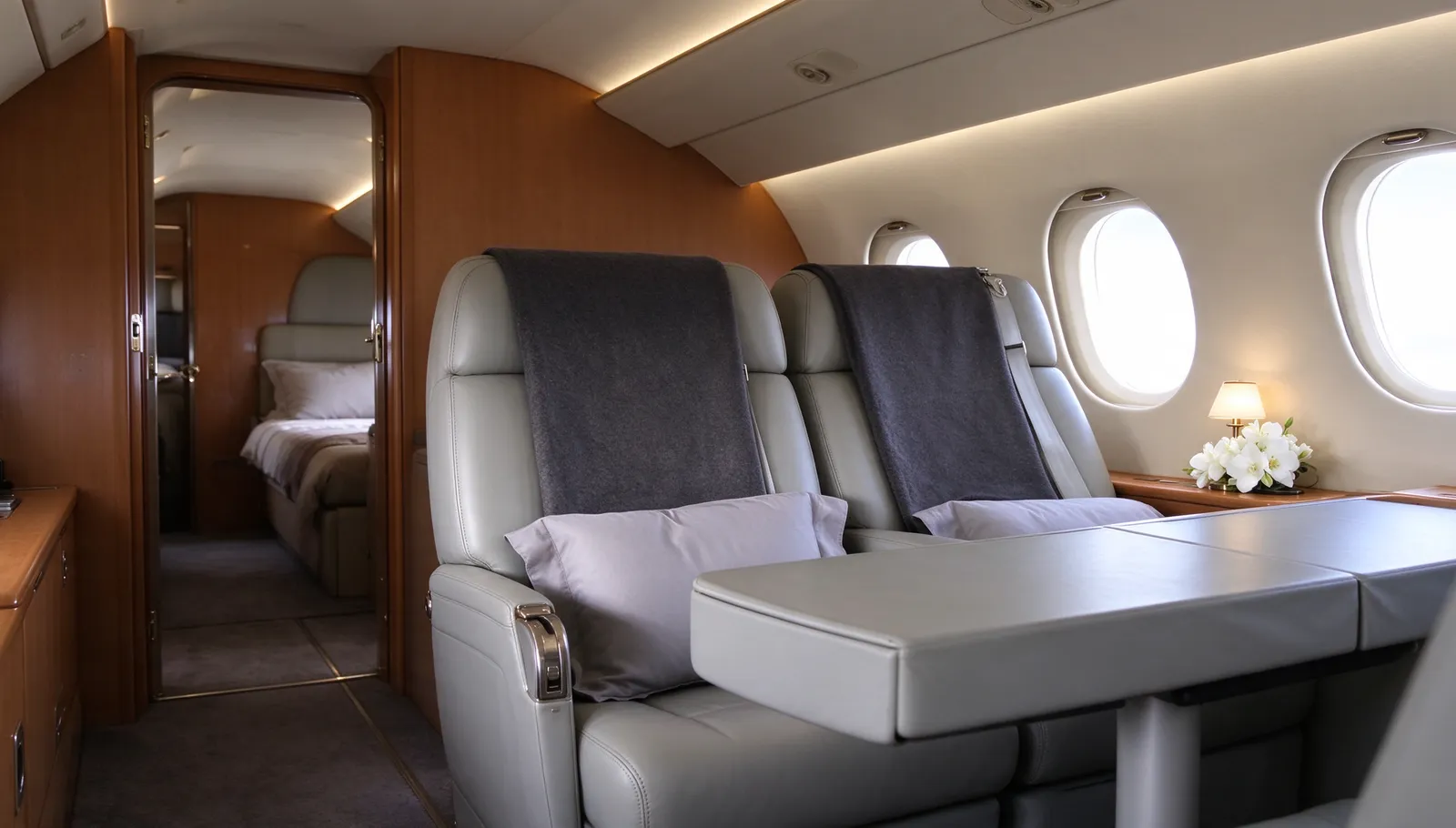
The standard executive layout seats 12, and high-density versions carry up to 19. The cabin is 10.11 m long, 2.3 m wide and 1.9 m high, so passengers can stand upright. The hold takes around 12 suitcases, and there is space for a further 10 carry-on bags, in 3.6 cubic metres.
How fast is the Falcon 900B?
It cruises at 474 knots (878 km/h), and its maximum operating speed is Mach 0.87. On European business routes that pace makes a short sector quick: Paris to Munich, for example, takes around 1 hour 15 minutes. For longer legs the long-range cruise speed is 426 knots.
How far will a Falcon 900B fly, and which cities can it link?
Its range with IFR reserves is 4,000 nautical miles (7,408 km). London to Miami, at about 7,100 km, falls within that figure and still leaves a margin for headwinds or routing changes. That makes the 900B a practical choice for transatlantic business trips without a fuel stop, subject to passenger numbers and weather on the day.
Gallery
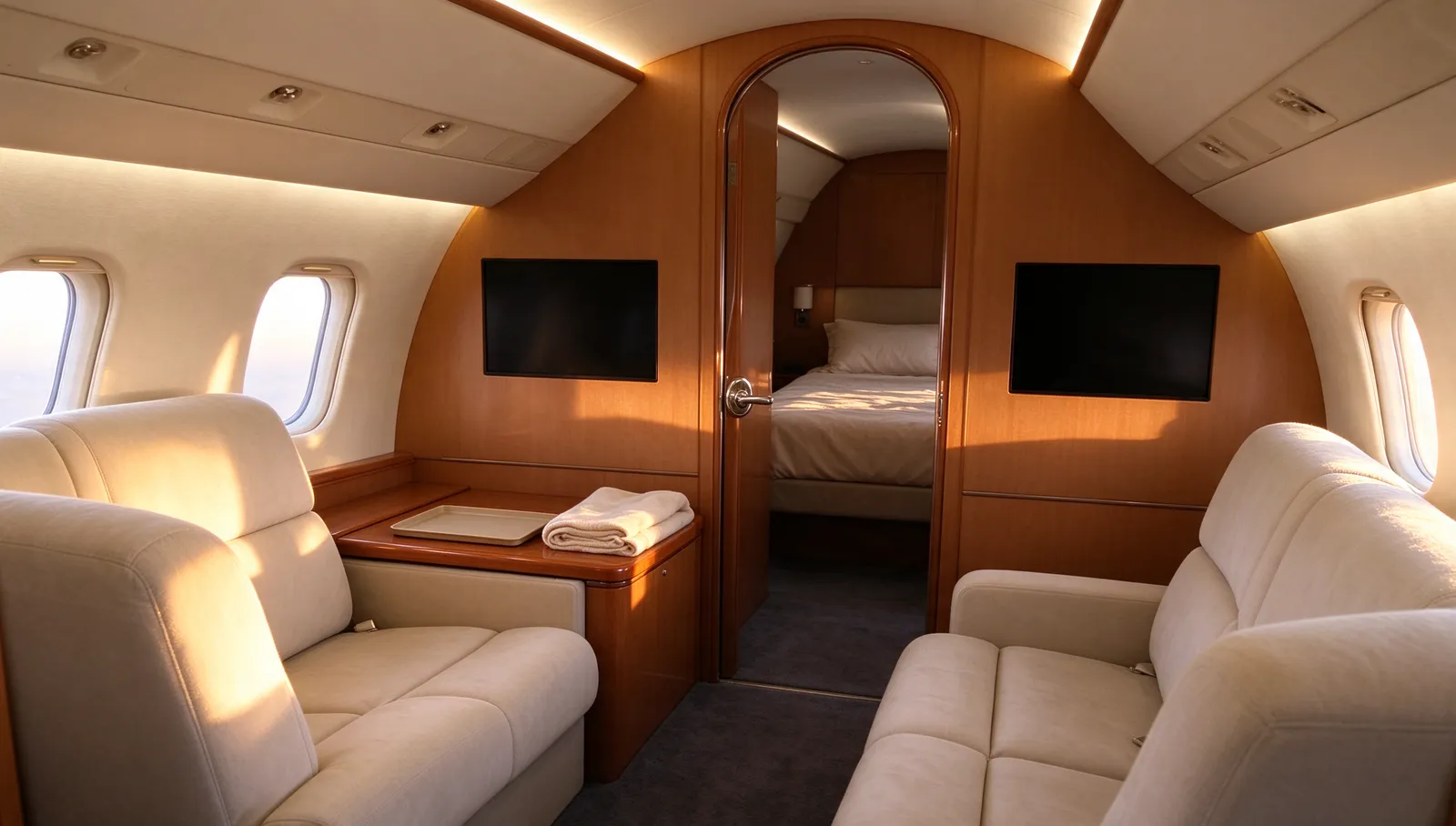
Figures are published manufacturer data, shown for illustration only. Images are generated for this concept and show the Falcon 900B type, not a specific aircraft. Dassault Aviation and Falcon 900B are trademarks of their owner, used only to identify the aircraft.