Super Large Jet
Dassault Falcon 900C
Range
4,000 NM
Cruise speed
474 kts
Seats
12
History
Dassault brought out the Falcon 900C in 2000 to replace the 900B, and customer deliveries started that year, with production running until 2005. Instead of developing new systems, Dassault built the 900C from proven, certified Falcon 900 components. The airframe came from the 900B, and the aircraft flies on three TFE731-5BR-1C turbofans with a Honeywell Primus 2000 avionics suite.
For existing Falcon operators, this meant better performance without having to learn unfamiliar systems, since procedures stayed close to those of the 900B. It filled the gap between the 900B and the 900DX, a more advanced model that came later, and it reflects Dassault's habit of developing the Falcon 900 family step by step to meet different customer requirements.
Technical Specifications
General information
| Model name | Falcon 900C |
|---|---|
| Manufacturer | Dassault Aviation |
| Aircraft category | super large jet |
| ICAO Designator | F900 |
| Start/End of Production | 1999 - 2005 |
| Number of pilot(s) | 2 |
Performances
| Range (with IFR reserves) | 4000 NM (7408 km) |
|---|---|
| Ferry range | 4600 NM (8519 km) |
| Cruise speed | 474 kts (878 km/h) |
| Max Operating Speed – VMO | 370 KIAS |
| Max Mach Operating Speed - MMO | Mach 0.87 |
| Long-Range Cruise Speed - LRC | 426 KTAS |
| Approach Speed | 110 kts |
| Takeoff Distance | 1585 m |
| Average Landing Distance | 671 m |
| Service Ceiling | 51000 ft |
| Thrust | 4750 lbf |
Aircraft technology
| Engine type | Turbofan |
|---|---|
| Engine(s) | 3 x TFE731-5BR-1C |
| Avionics | Honeywell Primus 2000 |
Dimensions and capacity
| Aircraft length | 20.24 m |
|---|---|
| Aircraft height | 7.53 m |
| Wing span | 19.33 m |
| Cabin height | 1.9 m (6.2 ft) |
| Cabin length | 10.11 m (33.17 ft) |
| Cabin width | 2.34 m (7.7 ft) |
| Baggage volume | 3.6 m3 |
| Seats (standard config) | 12 |
| Seats (max) | 19 |
| Suitcases | 12 |
| Carry-on luggage | 10 |
| Maximum payload | 21908 kg |
| Maximum TakeOff Weight - MTOW | 20640 kg |
| Maximum Landing Weight - MLW | 19051 kg |
FAQ
How far can the Falcon 900C fly without refuelling?
Its range with IFR reserves is 4,000 nm (7,408 km), and the ferry range is 4,600 nm. That is enough to reach Dubai from London, or Rome from New York, without a stop, which makes the 900C a practical choice for transatlantic trips and for routes into the Middle East. Payload and winds on the day decide the final figure.
How many passengers does the Falcon 900C seat?
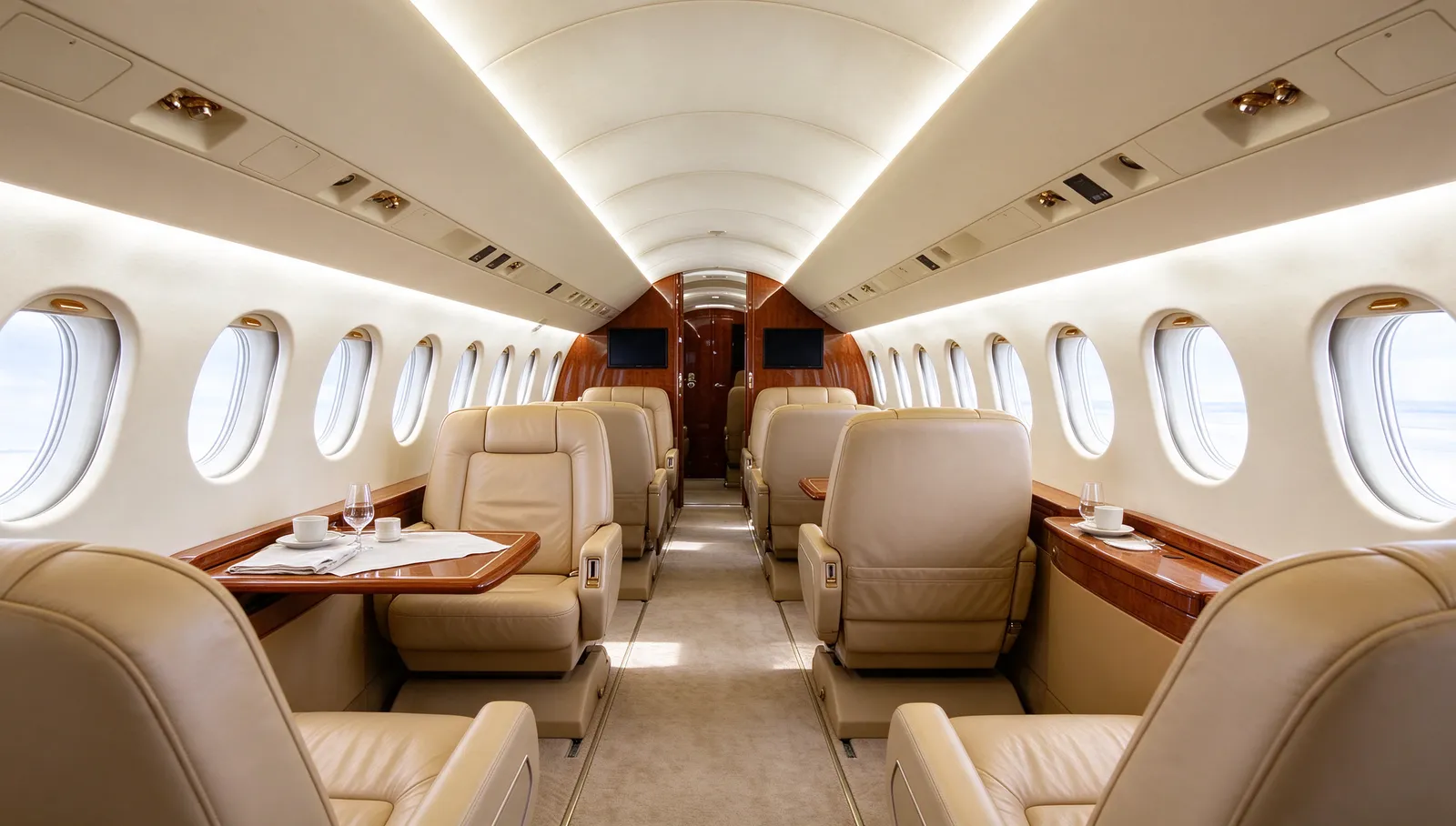
The standard layout seats 12, and the maximum is 19. The cabin is split into three sections that can be arranged in different ways, so operators can configure it to suit the trip. It measures 10.11 m long, 2.34 m wide and 1.9 m high, with 3.6 cubic metres of baggage space for around 12 suitcases.
What speed does the Falcon 900C cruise at?
It cruises at 474 kts (878 km/h), with a maximum operating speed of Mach 0.87. On a short European sector such as London to Paris the flight takes about 45 minutes, so a same-day return fits comfortably around a working day.
How does the 900C differ from the 900B and the 900EX?
Compared with the 900B, the 900C has identical range, 7,408 km, but uses fuel more efficiently. It does not have the larger fuel capacity of the 900EX, which flies 4,502 nm (8,338 km), roughly 930 km further, and can therefore skip a fuel stop on some longer intercontinental routes. In the family line-up, the 900C sits between the 900B and the later, more advanced 900DX.
Gallery
Figures are published manufacturer data, shown for illustration only. Images are generated for this concept and show the Falcon 900C type, not a specific aircraft. Dassault Aviation and Falcon 900C are trademarks of their owner, used only to identify the aircraft.