Large Jet
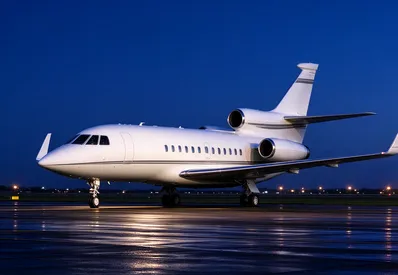
Dassault Falcon 900EX
Range
4,500 NM
Cruise speed
474 kts
Seats
12-14
History
Dassault put the Falcon 900EX into service in 1996 as a stronger version of its three-engined Falcon 900. Its Honeywell TFE731-60 engines produce 5,000 lb of thrust each, and the extra power gave it noticeably better performance than earlier versions.
The EX also carries more fuel. With a range of about 4,500 nm, it can fly intercontinental sectors that earlier Falcons had to break with a fuel stop, which gave operators routes they could not previously offer with this family.
Production of the 900EX ran until 2010, by which time Dassault was building the 900DX and the 900EX EASy. The original EX laid the groundwork for those later aircraft, from the EASy avionics upgrade to the models fitted with winglets, while keeping the three-engine layout that defines the series.
Technical Specifications
General information
| Model name | Falcon 900EX |
|---|---|
| Manufacturer | Dassault Aviation |
| Aircraft category | large jet |
| ICAO Designator | F900 |
| Start/End of Production | 1996 - 2010 |
| Number of pilot(s) | 2 |
Performances
| Range (with IFR reserves) | 4500 NM (8334 km) |
|---|---|
| Ferry range | 4500 NM (8334 km) |
| Cruise speed | 474 kts (878 km/h) |
| Max Operating Speed – VMO | 370 KIAS |
| Max Mach Operating Speed - MMO | Mach 0.87 |
| Long-Range Cruise Speed - LRC | 436 KTAS |
| Approach Speed | 110 kts |
| Takeoff Distance | 1524 m |
| Average Landing Distance | 732 m |
| Rate of Climb | 4000 ft/min |
| Service Ceiling | 51000 ft |
| Thrust | 5000 lbf |
Aircraft technology
| Engine type | Turbofan |
|---|---|
| Engine(s) | 3 x Honeywell TFE731-60 |
| Avionics | Honeywell Primus 2000 |
Dimensions and capacity
| Aircraft length | 20.21 m |
|---|---|
| Aircraft height | 7.55 m |
| Wing span | 21.38 m |
| Cabin height | 1.88 m (6.17 ft) |
| Cabin length | 10.11 m (33.17 ft) |
| Cabin width | 2.34 m (7.67 ft) |
| Baggage volume | 3.6 m3 |
| Seats (standard config) | 12-14 |
| Seats (max) | 19 |
| Suitcases | 12 |
| Carry-on luggage | 10 |
| Maximum payload | 1604 kg |
| Maximum TakeOff Weight - MTOW | 22225 kg |
| Maximum Landing Weight - MLW | 19051 kg |
| Fuel capacity | 11830 L |
FAQ
How does the Falcon 900EX's range compare with the Legacy 600's?
Yes, by a wide margin. The Falcon 900EX has a range of 4,500 nm (8,334 km) with IFR reserves, while the Legacy 600 is rated at 3,250 nm. That difference of roughly 1,250 nm means some routes that need a fuel stop in the Legacy can be flown direct in the Falcon, which saves time on the ground and keeps the itinerary simpler.
How many passengers fit in a Falcon 900EX?
Standard layouts seat 12 to 14, and the cabin is certified for up to 19. A common arrangement is two club groups of four seats with a three-seat sofa, so a group can sit together or spread out. The baggage area takes around 12 suitcases, and the cabin has room for about 10 pieces of hand luggage.
What does the EASy cockpit bring?
EASy stands for Enhanced Avionics System, the digital cockpit Dassault first installed on the Falcon 900 family in 2003. It cuts the crew's workload through automation and clear, integrated displays. When it appeared it was a significant development in business jet cockpits, and it kept the three-engine reliability for which the 900EX was already known.
Which routes can the Falcon 900EX fly nonstop?
With IFR reserves, the 900EX covers 4,500 nm (8,334 km). That makes a sector such as New York to Rome straightforward, with no fuel stop. Payload, winds and the season all affect the real figure, so our advisors check each route before quoting it.
How fast does the Falcon 900EX cruise?
Its normal cruise is 474 knots (878 km/h), and the crew can slow to a long range cruise of 436 knots to stretch the fuel on the longest legs. The maximum operating speed is Mach 0.87 and the ceiling 51,000 ft, which keeps it level with other large jets on speed.
Figures are published manufacturer data, shown for illustration only. Images are generated for this concept and show the Falcon 900EX type, not a specific aircraft. Dassault Aviation and Falcon 900EX are trademarks of their owner, used only to identify the aircraft.