Large Jet
Dassault Falcon 900LX
Range
4,750 NM
Cruise speed
474 kts
Seats
12
History
Dassault unveiled the 900LX at EBACE in 2008 as the newest step in a trijet line it had been developing for more than twenty years. The main change was a set of blended winglets shaped for high-Mach flight, the work of Aviation Partners Inc. EASA and the FAA certified the aircraft in July 2010, after testing of the winglet installation, and it is still in production.
The winglets added 7 per cent to the range of the 900EX, taking it to 4,750 nautical miles, and improved fuel efficiency. Power still comes from three proven Honeywell TFE731-60 engines, which give the 900LX advantages over twin-engine jets in airport access and safety margins. Counting every variant, more than 500 Falcon 900s are flying today.
Technical Specifications
General information
| Model name | Falcon 900LX |
|---|---|
| Manufacturer | Dassault Aviation |
| Aircraft category | large jet |
| ICAO Designator | F900 |
| Start/End of Production | 2010 - Still in production |
| Number of pilot(s) | 2 |
Performances
| Range (with IFR reserves) | 4750 NM (8797 km) |
|---|---|
| Ferry range | 5466 NM (10123 km) |
| Cruise speed | 474 kts (878 km/h) |
| Max Operating Speed – VMO | 370 KIAS |
| Max Mach Operating Speed - MMO | Mach 0.87 |
| Long-Range Cruise Speed - LRC | 459 KTAS |
| Approach Speed | 110 kts |
| Takeoff Distance | 1633 m |
| Average Landing Distance | 735 m |
| Service Ceiling | 51000 ft |
| Thrust | 5000 lbf |
Aircraft technology
| Engine type | Turbofan |
|---|---|
| Engine(s) | 3 x Honeywell TFE731-60 |
| Avionics | EASy II (Honeywell Primus Epic) |
Dimensions and capacity
| Aircraft length | 20.21 m |
|---|---|
| Aircraft height | 7.67 m |
| Wing span | 21.38 m |
| Cabin height | 1.88 m (6.17 ft) |
| Cabin length | 10.11 m (33.2 ft) |
| Cabin width | 2.34 m (7.67 ft) |
| Baggage volume | 3.6 m3 |
| Seats (standard config) | 12 |
| Seats (max) | 19 |
| Suitcases | 12 |
| Carry-on luggage | 10 |
| Maximum TakeOff Weight - MTOW | 22225 kg |
| Maximum Landing Weight - MLW | 20185 kg |
| Fuel capacity | 12586 L |
FAQ
Can the Falcon 900LX match the range of a Falcon 7X?
No. The 7X flies about 5,950 nautical miles (11,019 km), well beyond the 4,750 nautical miles (8,797 km) of the 900LX. Both are Dassault trijets, but the 7X is a larger and more advanced design built for longer sectors. Where the route sits within its range, the 900LX remains a strong option.
What is the 900LX's cruise speed?
It cruises at 474 knots (878 km/h), quick for a large jet. Blended winglets and the TFE731-60 engines underpin that figure, and the aircraft keeps the operating advantages of a three-engine design, which makes it efficient on long transcontinental routes.
How far can the Falcon 900LX fly?
With IFR reserves, the 900LX covers 4,750 nautical miles (8,797 km). For positioning flights without passengers, its ferry range extends to 5,466 nautical miles (10,123 km). That brings many intercontinental city pairs within a single flight, and our advisors check each route against the operator's performance figures before confirming.
How many passengers does the 900LX seat?
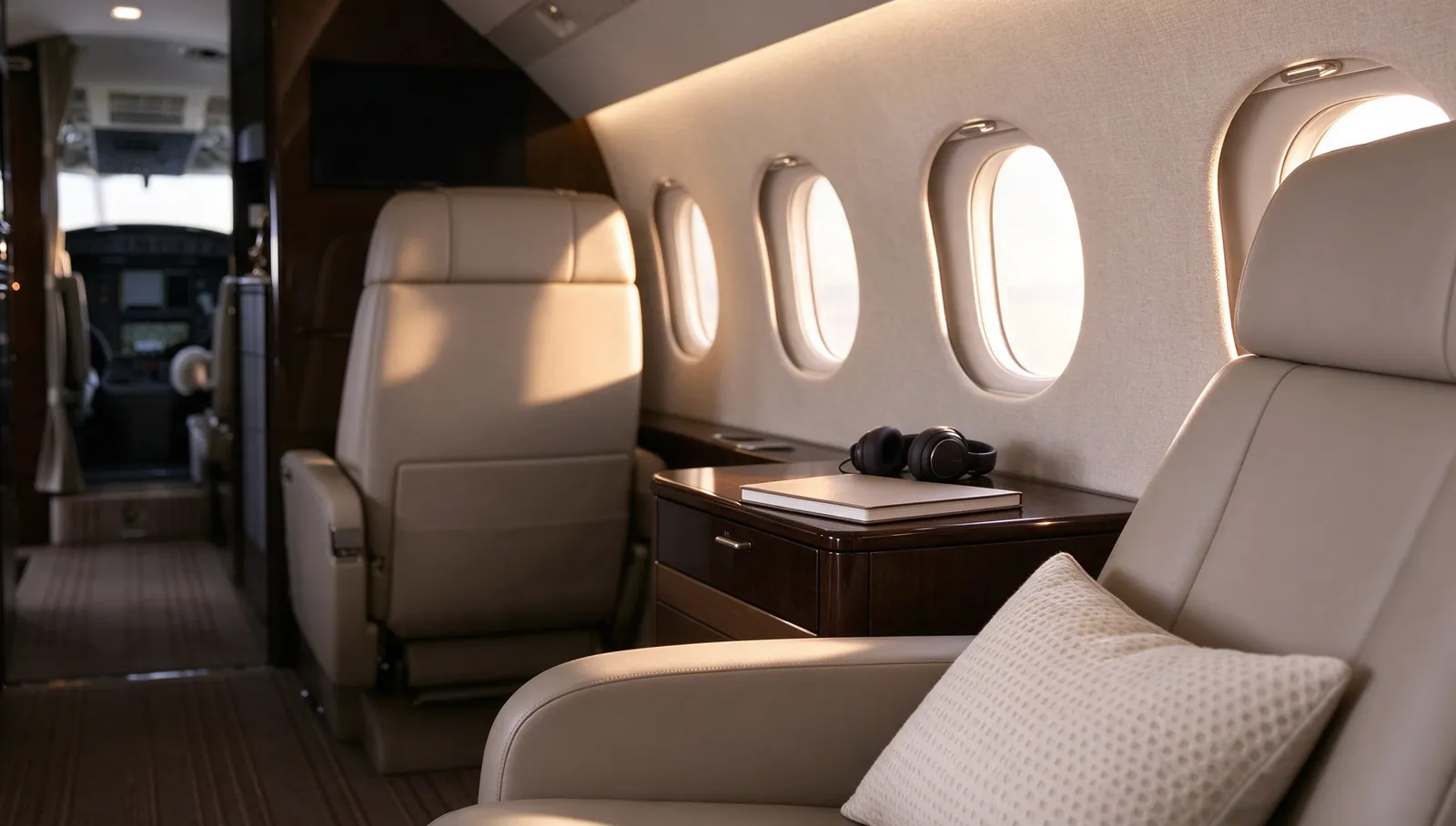
Standard configuration is 12 seats, with certification for up to 19 depending on the interior. The cabin measures 10.11 metres long, 2.34 metres wide and 1.88 metres high, divided into three zones that can be set up for seating, work or rest. Luggage space takes around 12 suitcases and 10 carry-on bags.
What does a third engine give the 900LX over twin-engine jets?
Three engines let the 900LX use airports with restrictive approach procedures that some twins cannot, and it performs better at high altitude and in hot weather. The extra engine adds redundancy if one fails and helps it keep climbing in difficult conditions. Balanced engine placement also contributes to a quieter cabin.
Gallery
Figures are published manufacturer data, shown for illustration only. Images are generated for this concept and show the Falcon 900LX type, not a specific aircraft. Dassault Aviation and Falcon 900LX are trademarks of their owner, used only to identify the aircraft.