Midsize Jet
Embraer Legacy 500
Range
3,125 NM
Cruise speed
466 kts
Seats
8
History
The Legacy 500 began in April 2008, when Embraer set out plans for a new generation of midsize business jets. The aim was an aircraft that sat between the smaller and larger jets on the market and brought in systems not previously seen in its class. Embraer rolled out the first prototype on 23 December 2011, its engines were run for the first time on 17 January 2012, and it flew on 27 November 2012.
No earlier midsize jet had fly-by-wire flight controls, and the Legacy 500 also brought a flat floor and stand-up headroom to the category. Certification came on 12 August 2014. Two Honeywell HTF7500E turbofans give it a cruise speed of 466 kts, and the flight deck uses Rockwell Collins Pro Line Fusion avionics.
In October 2018 Embraer developed the design into the Praetor 600, adding fuel tanks for more range. Owners of the smaller Legacy 450 could have their aircraft upgraded to Praetor 500 standard, but structural differences meant a Legacy 500 could not be converted into a Praetor 600, so customers had to buy a new aircraft. The Legacy 500 stayed in production until 2020.
Technical Specifications
General information
| Model name | Legacy 500 |
|---|---|
| Manufacturer | Embraer |
| Aircraft category | midsize jet |
| ICAO Designator | E550 |
| Start/End of Production | 2014 - 2020 |
| Number of pilot(s) | 2 |
Performances
| Range (with IFR reserves) | 3125 NM (5787 km) |
|---|---|
| Ferry range | 3300 NM (6112 km) |
| Cruise speed | 466 kts (863 km/h) |
| Max Operating Speed – VMO | 320 KIAS |
| Max Mach Operating Speed - MMO | Mach 0.83 |
| Long-Range Cruise Speed - LRC | 436 KTAS |
| Approach Speed | 121 kts |
| Takeoff Distance | 1402 m |
| Average Landing Distance | 644 m |
| Service Ceiling | 45000 ft |
| Thrust | 7036 lbf |
Aircraft technology
| Engine type | Turbofan |
|---|---|
| Engine(s) | 2 x Honeywell HTF7500E |
| Avionics | Rockwell Collins Pro Line Fusion |
Dimensions and capacity
| Aircraft length | 20.74 m |
|---|---|
| Aircraft height | 6.44 m |
| Wing span | 20.25 m |
| Cabin height | 1.82 m (6.0 ft) |
| Cabin length | 8.38 m (27.5 ft) |
| Cabin width | 2.10 m (6.92 ft) |
| Baggage volume | 4.4 m3 |
| Seats (standard config) | 8 |
| Seats (max) | 12 |
| Suitcases | 9 |
| Carry-on luggage | 4 |
| Maximum payload | 1300 kg |
| Maximum TakeOff Weight - MTOW | 17400 kg |
| Maximum Landing Weight - MLW | 15650 kg |
FAQ
Is the Legacy 650 a better choice than the Legacy 500 for longer trips?
For range, yes. The Legacy 650 is rated for 3,900 nm (7,223 km), roughly 775 nm more than the Legacy 500's 3,125 nm (5,787 km), which can remove a fuel stop on longer routes. The Legacy 500 is the more modern design, though, with fly-by-wire controls and a 2014 entry into service, so it suits trips within its range well.
What cruise speed does the Legacy 500 fly at?
Typical cruise is 466 kts (863 km/h), with a long-range cruise speed of 436 kts and a maximum operating speed of Mach 0.83. On European routes, a Madrid trip from London takes less than two hours, and Frankfurt to Rome around an hour and a half, which suits business travel where time matters.
How many people can travel in the Legacy 500?
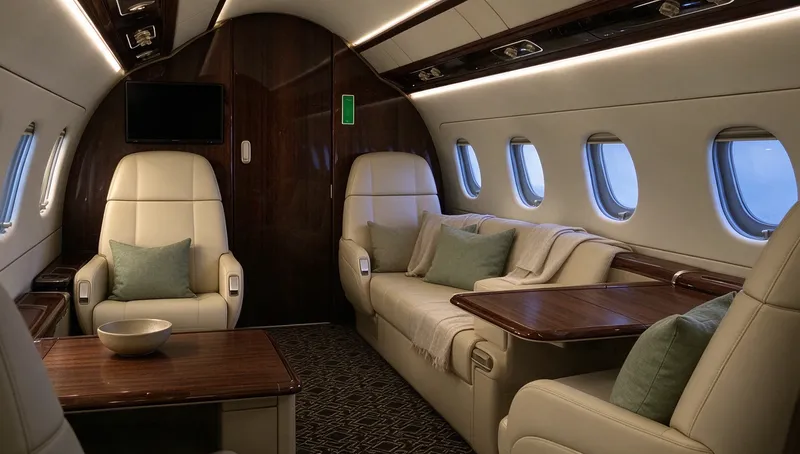
Eight in a standard layout, and up to 12 at most. The cabin has a flat floor and measures 8.38 m long, 2.10 m wide and 1.82 m high, so passengers can stand and move around freely. The baggage area takes 9 suitcases and 4 carry-on bags, enough for a longer business trip.
Which routes can the Legacy 500 fly without a stop?
With 3,125 nm (5,787 km) of range under IFR reserves, it can fly New York to Los Angeles or London to Dubai in one leg. That puts transcontinental trips, and many intercontinental ones, within a single flight, although the payload and winds on the day set the final figure.
What does fly-by-wire mean for passengers on the Legacy 500?
Full fly-by-wire controls, a system previously found on larger airliners, appeared on a midsize jet for the first time with this aircraft. It reduces pilot workload by managing many flight parameters automatically and protects against stalls and other unsafe conditions. Passengers feel the difference as a steadier ride in turbulence, and the system also contributes to better fuel efficiency.
Gallery
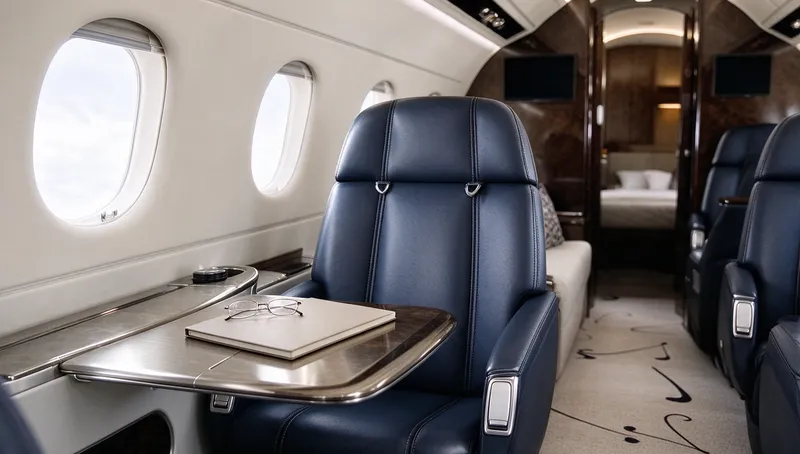
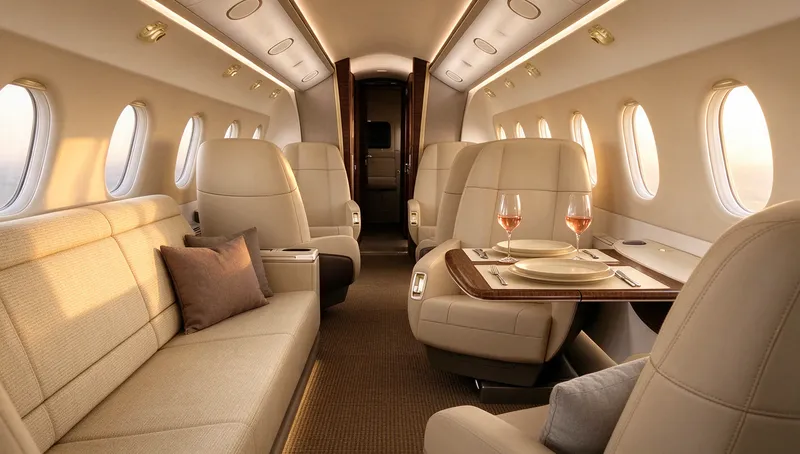
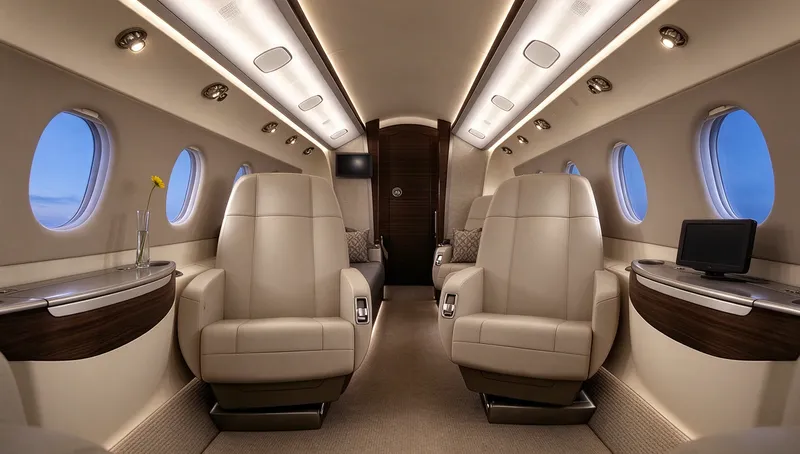
Figures are published manufacturer data, shown for illustration only. Images are generated for this concept and show the Legacy 500 type, not a specific aircraft. Embraer and Legacy 500 are trademarks of their owner, used only to identify the aircraft.