Turboprop
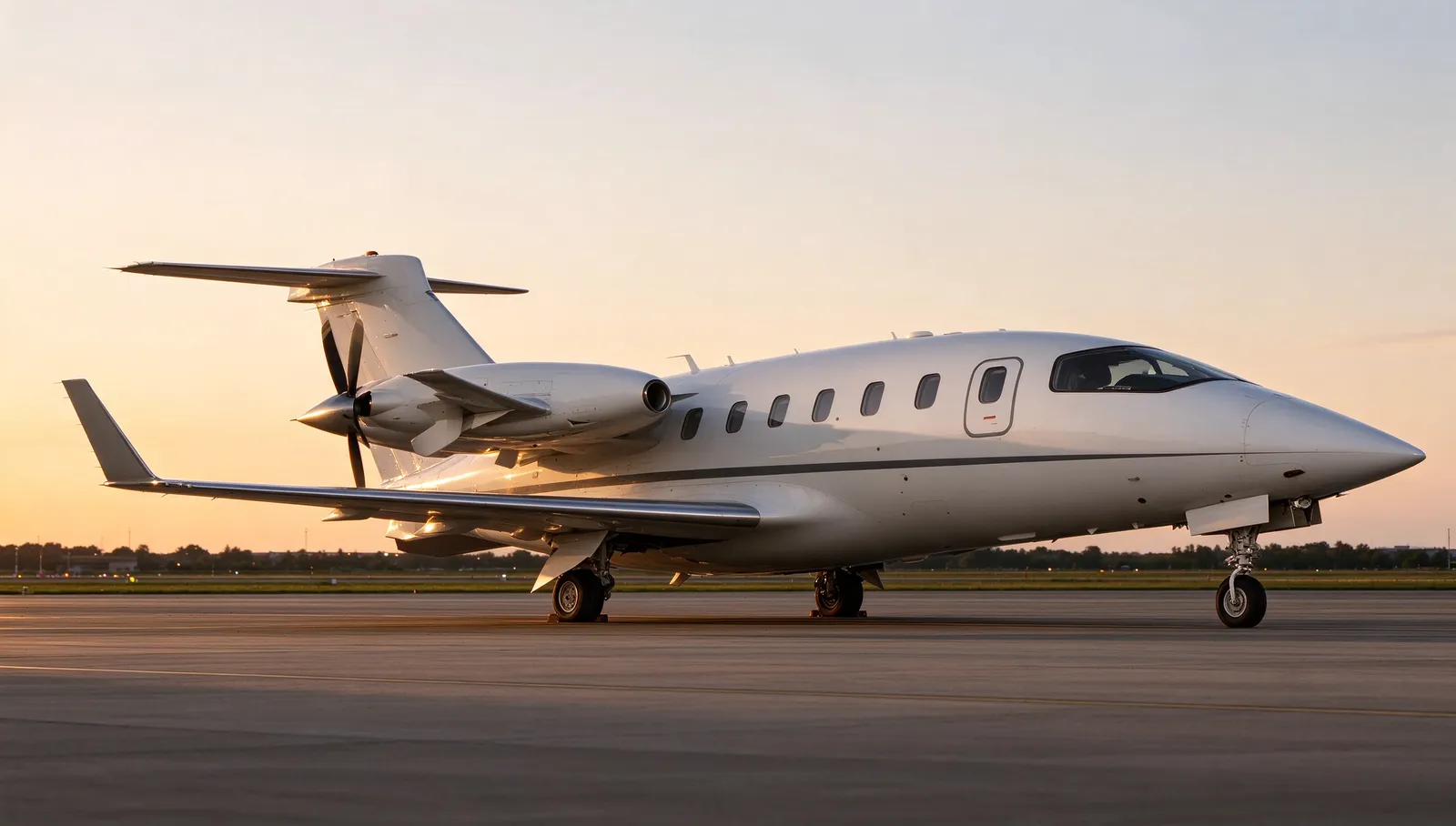
Piaggio Avanti P180 II
Range
1,470 NM
Cruise speed
400 kts
Seats
6
History
Few business aircraft look like the Avanti. Its two engines face backwards and drive pusher propellers, and it flies on three lifting surfaces: the main wing, the tailplane and a pair of canards either side of the nose. The layout is there for performance as much as looks, and it lets the Avanti outpace and outrange many other turboprops.
Placing the engines at the rear makes the cabin quieter and reduces turbulence over the wing, while the three surfaces cut drag. The outcome is a turboprop with the speed and range to compete with some light jets: it cruises at 400 kts (741 km/h), reaches 41,000 ft and is close to 40% more fuel-efficient than most business jets, while costing less to buy and run.
The Avanti II replaced the original P180 when Piaggio launched it in 2004, and production continued until 2014. That year Flying Magazine named it the fastest civil twin turboprop and put its speed on a par with Cessna's jet-powered M2, while noting that the Avanti offers more cabin space at lower operating costs. Inside, the cabin is quieter, taller and wider than any aircraft in Cessna's CJ range.
Piaggio announced the Avanti EVO in 2014, with new propellers, revised winglets and more fuel. Those changes added 500 km of range, improved the climb, lowered fuel burn and cut external noise considerably, and deliveries of the EVO began in April 2015.
Technical Specifications
General information
| Model name | Avanti P180 II |
|---|---|
| Manufacturer | Piaggio Aerospace |
| Aircraft category | turboprop |
| ICAO Designator | P180 |
| Start/End of Production | 2005 - 2014 |
| Number of pilot(s) | 1-2 |
Performances
| Range (with IFR reserves) | 1470 NM (2722 km) |
|---|---|
| Ferry range | 1530 NM (2834 km) |
| Cruise speed | 400 kts (741 km/h) |
| Max Operating Speed – VMO | 260 KIAS |
| Long-Range Cruise Speed - LRC | 314 KTAS |
| Approach Speed | 120 kts |
| Takeoff Distance | 986 m |
| Average Landing Distance | 1000 m |
| Rate of Climb | 2950 ft/min |
| Service Ceiling | 41000 ft |
| Thrust | 850 shp |
Aircraft technology
| Engine type | Turboprop |
|---|---|
| Engine(s) | 2 x Pratt & Whitney Canada PT6A-66B |
| Avionics | Rockwell Collins Pro Line 21 |
Dimensions and capacity
| Aircraft length | 14.41 m |
|---|---|
| Aircraft height | 3.98 m |
| Wing span | 14.03 m |
| Cabin height | 1.75 m (5.75 ft) |
| Cabin length | 4.55 m (14.9 ft) |
| Cabin width | 1.85 m (6.1 ft) |
| Baggage volume | 1.25 m3 |
| Seats (standard config) | 6 |
| Seats (max) | 9 |
| Suitcases | 3 |
| Carry-on luggage | 4 |
| Maximum payload | 816 kg |
| Maximum TakeOff Weight - MTOW | 5489 kg |
| Maximum Landing Weight - MLW | 5216 kg |
| Fuel capacity | 1585 L |
Advantages & Disadvantages
Advantages
- Jet-like pace: For a turboprop the Avanti is unusually fast, and its cruise speed, altitude and range come close to those of a light jet.
- Good value: It is one of the least expensive ways for a small group to fly privately, though the price varies with the version (P180 Avanti, Avanti II or Avanti EVO) and the aircraft's equipment.
- Short-runway access: The wing design and engine power let it use shorter runways than many jets and turboprops of a similar size, which brings airports that are remote or difficult to get into within range.
- Distinctive design: The Avanti stands out on any apron, and its shape is functional, since the same layout is what gives it above-average performance.
- Lower emissions: Its turboprop engines emit considerably less than conventional jet engines, which suits travellers and companies trying to cut the environmental impact of their flying.
Disadvantages
- Some noise and vibration: The Avanti is much quieter than most turboprops, but the rear-mounted pusher propellers still produce the characteristic turboprop sound and some vibration that passengers can feel. Travellers who are sensitive to noise may prefer a jet.
- Range for longer trips: Its range beats many aircraft in its class, but long sectors may need a fuel stop. Jets that seat a similar number, the Cessna Citation CJ4 or Embraer Phenom 300 for example, fly considerably further on a full tank.
FAQ
What does it cost to charter a Piaggio Avanti?
Rates depend on the trip rather than a fixed tariff. Route and flight time, travel dates, the aircraft's position before your flight and the operator all shape the final figure, as do the version (Avanti II or EVO) and its equipment. An advisor at Hesper Jets will quote each request individually.
How fast does the Avanti P180 II fly?
It cruises at 400 kts (741 km/h), which is unusually quick for a turboprop and close to light jet territory. Two Pratt & Whitney Canada PT6A-66B engines drive pusher propellers, and the three lifting surfaces keep drag low, so the Avanti combines that speed with the low fuel consumption of a turboprop.
Is there a toilet on board?
Yes. The Avanti has a lavatory equipped with a toilet, a sink and a water supply, which makes longer legs more comfortable for passengers. Ask our advisors for the layout of a particular aircraft if it matters to you, as interiors vary between operators.
Can one pilot fly the Avanti?
Yes. The P180 holds single-pilot certification, with modern avionics, including a Rockwell Collins Pro Line 21 suite, and safety systems that support one pilot. Operators can still fly it with two pilots when they prefer or when the mission calls for it.
How many passengers and bags can the Avanti take?
The standard layout seats six, and up to nine can fit in a maximum-seating configuration. There is space for four carry-on bags and three suitcases, which is enough for most medium-distance trips but worth checking if your group is travelling with bulky luggage.
Avanti P180 II or Pilatus PC-12 NGX: which is faster?
The Avanti, by a wide margin. It cruises at 400 kts (741 km/h), compared with 290 kts (537 km/h) for the single-engine PC-12 NGX. The Pilatus has other strengths: it needs roughly half the runway to take off and land, it can use unpaved strips, and it has slightly more range with a cabin of similar volume.
How far can the Avanti fly?
Its range with IFR reserves is 1,470 nm (2,722 km), and its ferry range is 1,530 nm (2,834 km). That allows non-stop flights such as Istanbul from London or Miami from New York, which makes it well suited to medium-haul routes across Europe.
Avanti EVO or King Air 350iER: what are the trade-offs?
The Avanti EVO is much faster and has more cabin volume. The King Air 350iER flies further and carries more payload with full tanks, but it costs more to buy. The choice usually comes down to what matters more on your trip: the Avanti's speed and space, or the King Air's extra range and payload.
Gallery
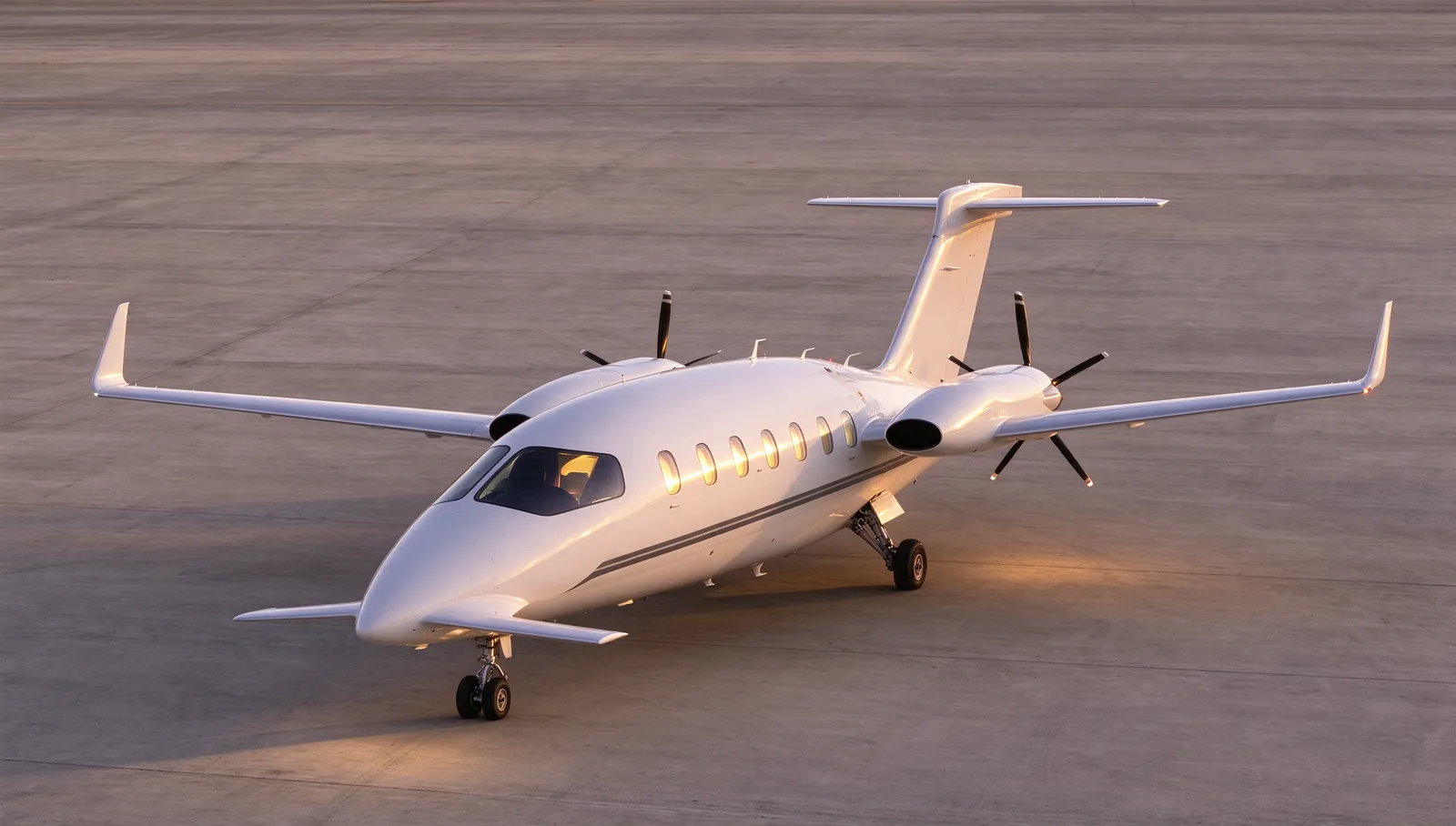
Figures are published manufacturer data, shown for illustration only. Images are generated for this concept and show the Avanti P180 II type, not a specific aircraft. Piaggio Aerospace and Avanti P180 II are trademarks of their owner, used only to identify the aircraft.