Turboprop
Pilatus PC-12 NGX
Range
1,803 NM
Cruise speed
290 kts
Seats
6-9
History
Pilatus began developing the original PC-12 in 1989. It first flew on 31 May 1991 and entered service in 1994 after Swiss and FAA certification. More than 1,750 aircraft have since been delivered across all variants, making it the most popular single-engine turboprop in the world. The NGX is the third generation of the family. Pilatus revealed it in October 2019 at the NBAA show, by which point it had already been certified.
Its Pratt & Whitney Canada PT6E-67XP engine is the first in a single-engine turboprop to have dual-channel electronic control of both engine and propeller. That allows an autothrottle and a quiet mode, which lowers propeller speed to 1,550 rpm, down from 1,700, with no loss of power.
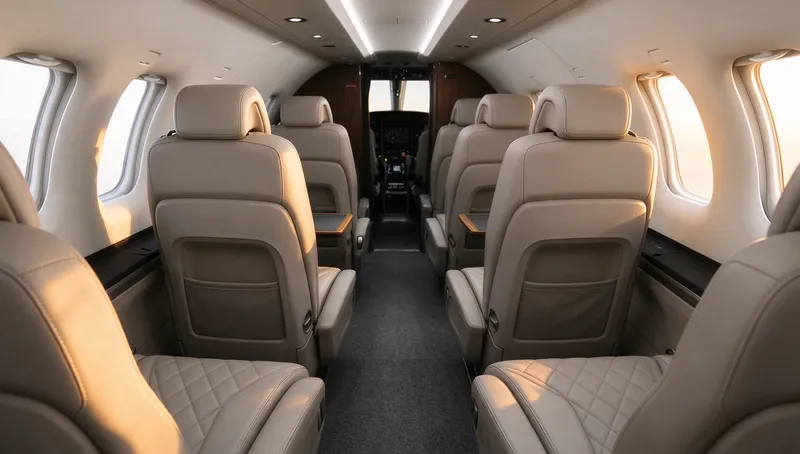
The cabin was redesigned from scratch with BMW Designworks, and its larger windows are borrowed from the PC-24 jet. In the cockpit, the Advanced Cockpit Environment uses four high-resolution displays and updated Honeywell avionics. The first aircraft was delivered in May 2020, and the NGX remains in production, flown by one pilot or two.
Technical Specifications
General information
| Model name | PC-12 NGX |
|---|---|
| Manufacturer | Pilatus Aircraft |
| Aircraft category | turboprop |
| ICAO Designator | PC12 |
| Start/End of Production | 2020 - Still in production |
| Number of pilot(s) | 1-2 |
Performances
| Range (with IFR reserves) | 1803 NM (3339 km) |
|---|---|
| Ferry range | 1889 NM (3500 km) |
| Cruise speed | 290 kts (537 km/h) |
| Max Operating Speed – VMO | 240 KIAS |
| Long-Range Cruise Speed - LRC | 262 KTAS |
| Approach Speed | 85 kts |
| Takeoff Distance | 757 m |
| Average Landing Distance | 661 m |
| Rate of Climb | 1920 ft/min |
| Service Ceiling | 30000 ft |
| Thrust | 1200 shp |
Aircraft technology
| Engine type | Turboprop |
|---|---|
| Engine(s) | 1 x Pratt & Whitney Canada PT6E-67XP |
| Avionics | Honeywell Primus Epic 2.0 (Pilatus ACE) |
Dimensions and capacity
| Aircraft length | 14.4 m |
|---|---|
| Aircraft height | 4.26 m |
| Wing span | 16.28 m |
| Cabin height | 1.47 m (4.82 ft) |
| Cabin length | 5.16 m (16.9 ft) |
| Cabin width | 1.52 m (5.0 ft) |
| Baggage volume | 1.13 m3 |
| Seats (standard config) | 6-9 |
| Seats (max) | 10 |
| Suitcases | 5 |
| Carry-on luggage | 3 |
| Maximum payload | 1035 kg |
| Maximum TakeOff Weight - MTOW | 4740 kg |
| Maximum Landing Weight - MLW | 4500 kg |
| Fuel capacity | 1522 L |
Advantages & Disadvantages
Advantages
- Modern engine control: The PT6E-67XP is the latest version of Pratt & Whitney Canada's proven PT6, and the NGX is the first aircraft in its class with electronic engine and propeller control. The system raises the maximum climb rate and airspeed, and a low-speed propeller mode makes the cabin noticeably quieter.
- Jet-style cabin: Comfort features from the Pilatus PC-24 jet carry over to the turboprop. The cabin, developed with BMW Designworks, has larger windows for more daylight, leather seats that recline fully flat, onboard Wi-Fi and power and USB sockets.
- Rough and short strips: The NGX needs only 757 metres to take off and can operate from unpaved runways, so it lands where other aircraft of its size cannot. That often means landing nearer the final destination than a jet or twin-engine aircraft could manage.
- Cabin and cargo space: There is room for up to 10 passengers with their luggage plus one pilot, and the 9.34 cubic metre cabin gives tall passengers enough head and legroom. A large cargo door at the rear makes bulky items easy to load, and the hold can be reached during the flight.
- Proven design: The NGX is the latest in the world's best-selling family of single-engine turboprops, with more than 1,750 delivered, and it is powered by the dependable PT6. Its safety record is on a par with that of twin-engine business jets.
Disadvantages
- Fewer aircraft available: Deliveries began in 2020, and Pilatus deliberately limits its production capacity, so relatively few NGX aircraft are on offer for charter at any one time.
- Slower than jets: The NGX is fast for a turboprop but slower than a business jet. When the priority is reaching a distant destination quickly, the Pilatus PC-24 jet is the faster option.
FAQ
Which airports can the PC-12 NGX reach?
It can use smaller airports and airfields, which shortens the transfer at either end. Examples include Saanen, about 3 km from Gstaad, Lausanne-Blécherette, a kilometre from the city centre, Toussus-le-Noble southwest of Paris, Annemasse near Geneva, Marina di Campo on Elba and St Barthélemy in the Caribbean. Plenty of safari lodges in South Africa are also within its reach.
Is there a toilet on board the PC-12 NGX?
Yes. Every NGX comes with an enclosed toilet and a refreshment centre as standard. The toilet sits between the cockpit and the cabin, which leaves the way clear to the rear cargo compartment, so passengers can reach their luggage during the flight.
How many pilots fly the PC-12 NGX?
One. Like every Pilatus aircraft, the NGX is certified for single-pilot operation, which is only granted when the workload suits a single pilot, and its updated cockpit makes it easier to fly than earlier versions. A co-pilot seat is fitted, so operators can also fly it with two pilots.
How does the PC-12 NGX compare with the Daher TBM 940?
Both use Pratt & Whitney Canada engines and Hartzell propellers with similar performance. The TBM 940 is slightly faster and flies higher, while the PC-12 NGX has more range and a larger cabin, with room for a permanently separate toilet where the TBM uses a convertible seat behind mobile partitions. The smaller TBM costs less to operate, so it can be the cheaper option when you do not need the space.
Does the PC-12 NGX fly as far as the PC-24?
No, the PC-24 jet flies further and faster. The NGX covers 1,803 nautical miles (3,339 km), enough for Paris to Rome or London to Madrid. In return it can operate from short or unpaved strips closed to the PC-24, costs less to run with a single engine, loads bulky luggage easily through its rear door and seats up to 10, against a typical 8 in the PC-24.
How many passengers fit in the PC-12 NGX?
Standard layouts seat 6 to 9, and the maximum is 10 plus the pilot. The cabin is 5.16 metres long, 1.52 metres wide and 1.47 metres high, with 9.34 cubic metres of volume, so tall passengers sit comfortably. A cargo door measuring 1.32 by 1.35 metres makes bulky luggage easy to load.
How fast is the PC-12 NGX?
It cruises at up to 290 knots (537 km/h), which places it among the fastest single-engine turboprops. The PT6E-67XP engine and its electronic propeller and engine control account for the gain over earlier PC-12 versions. For longer trips, a jet such as the PC-24 is quicker.
What does it cost to charter a PC-12 NGX?
There is no set rate. The price depends on the route, your dates, where the nearest suitable aircraft is positioned and which operator flies it. Our advisors price each trip individually, and the lower running costs of a single engine often help on shorter routes.
Gallery
Figures are published manufacturer data, shown for illustration only. Images are generated for this concept and show the PC-12 NGX type, not a specific aircraft. Pilatus Aircraft and PC-12 NGX are trademarks of their owner, used only to identify the aircraft.