Super Light Jet
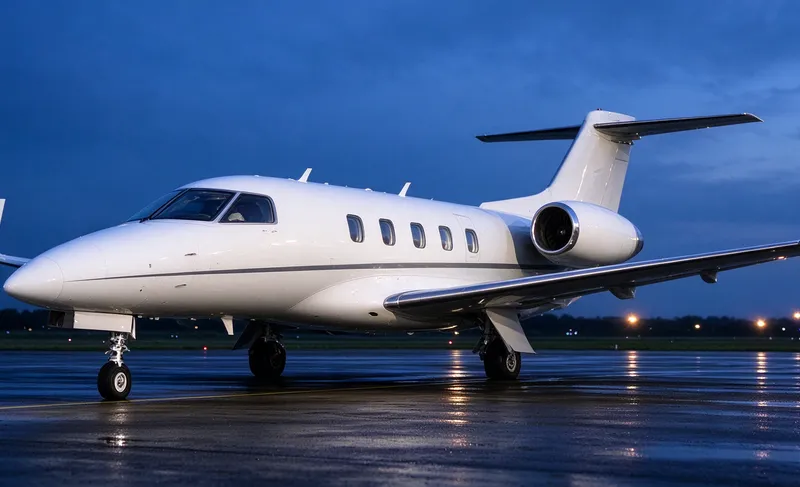
Pilatus PC-24
Range
2,000 NM
Cruise speed
440 kts
Seats
6-8
History
Pilatus designed the PC-24 to give passengers a well-judged balance of performance and comfort in the super light jet class. The Swiss manufacturer combined new ideas with technology it had already proven, and the market responded quickly: when orders opened, the order book filled in only 36 hours. Production began in 2018 and continues, and the type can be flown by one pilot or two.
Technical Specifications
General information
| Model name | PC-24 |
|---|---|
| Manufacturer | Pilatus Aircraft |
| Aircraft category | super light jet |
| ICAO Designator | PC24 |
| Start/End of Production | 2018 - Still in production |
| Number of pilot(s) | 1-2 |
Performances
| Range (with IFR reserves) | 2000 NM (3704 km) |
|---|---|
| Ferry range | 2123 NM (3932 km) |
| Cruise speed | 440 kts (815 km/h) |
| Max Operating Speed – VMO | 290 KIAS |
| Max Mach Operating Speed - MMO | Mach 0.74 |
| Long-Range Cruise Speed - LRC | 372 KTAS |
| Approach Speed | 98 kts |
| Takeoff Distance | 942 m |
| Average Landing Distance | 734 m |
| Rate of Climb | 3960 ft/min |
| Service Ceiling | 45000 ft |
| Thrust | 3420 lbf |
Aircraft technology
| Engine type | Turbofan |
|---|---|
| Engine(s) | 2 x Williams FJ44-4A |
| Avionics | Pilatus ACE (Honeywell Primus Epic 2.0) |
Dimensions and capacity
| Aircraft length | 16.8 m |
|---|---|
| Aircraft height | 5.3 m |
| Wing span | 17 m |
| Cabin height | 1.55 m (5.1 ft) |
| Cabin length | 7.01 m (23.0 ft) |
| Cabin width | 1.69 m (5.6 ft) |
| Baggage volume | 2.5 m3 |
| Seats (standard config) | 6-8 |
| Seats (max) | 10-12 |
| Suitcases | 6 |
| Carry-on luggage | 3 |
| Maximum payload | 1406 kg |
| Maximum TakeOff Weight - MTOW | 8500 kg |
| Maximum Landing Weight - MLW | 7865 kg |
| Fuel capacity | 3362 L |
Advantages & Disadvantages
Advantages
- Jet speed: Two Williams FJ44-4A turbofans give the PC-24 far more power than Pilatus's older and smaller PC-12 turboprop. It cruises at 815 km/h (440 kts), bringing more distant destinations within a reasonable flight time, which is what many turboprop owners had asked Pilatus for.
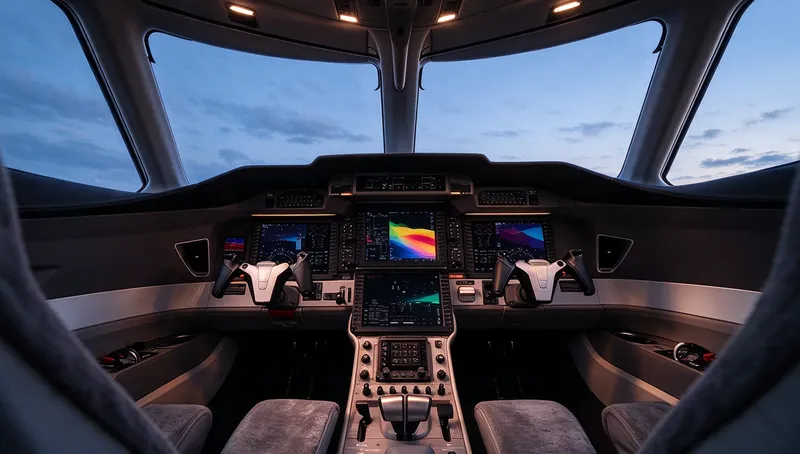
- Single-pilot certified: As with all Pilatus types, one pilot can fly it. Its Pilatus ACE avionics, based on Honeywell's Primus Epic 2.0, use automation to reduce pilot workload and include advanced safety features.
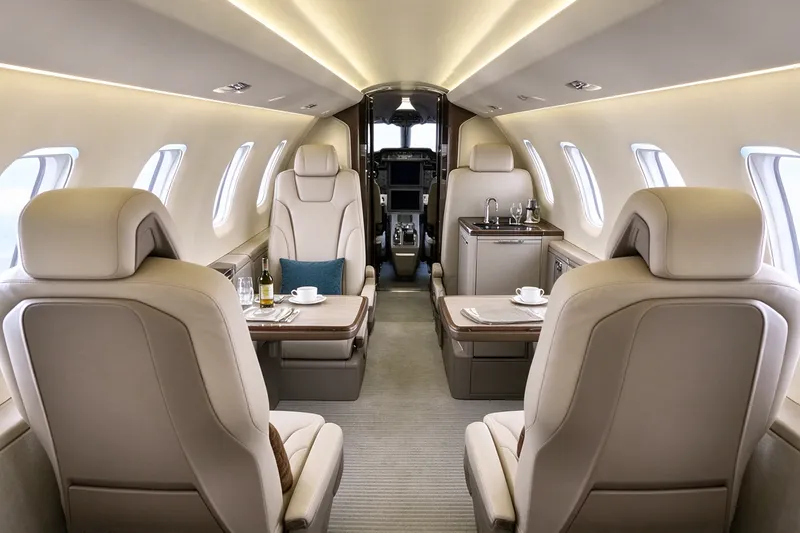
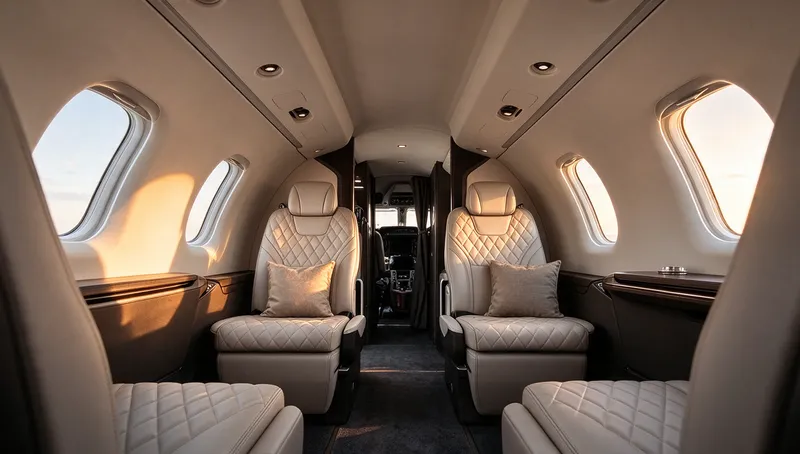
- Adaptable cabin: Seats come out easily and the cargo divider can be moved, so the layout can be matched to each group, and the flat floor makes the cabin feel open.
- Unpaved runways: No other business jet is certified to land away from paved runways. Its EASA approval extends to strips of snow, grass, gravel and sand, and it needs less runway than its competitors, which opens up many small airfields.
- Generous space: It pairs light jet performance with a cabin closer in size to a medium-light jet, with plenty of head and leg room for taller passengers. A pallet-sized cargo door comes as standard and allows loading by forklift, and the pressurised baggage area can be reached from the cabin in flight.
Disadvantages
- Limited supply: The PC-24 is younger than most of its competitors, and Pilatus had delivered only 75 by the end of its 2019 financial year. Depending on where you depart, there may be fewer aircraft to choose from.
- Less suited to very short hops: Its speed advantage shows on longer sectors. Below about 600 km, flight times are similar to a turboprop, while fuel burn is roughly double, and that can be reflected in the charter price.
FAQ
How much does it cost to charter a PC-24?
There is no standard price. Each quote reflects the route and flight time, the dates you choose, how far the aircraft must reposition and the operator's rates. The PC-24's lower operating costs compared with some rivals can work in your favour, but an advisor will cost your exact trip before you commit.
Which airports can a PC-24 reach?
Its short-field performance and certifications open up many small and remote airports. Examples include Lugano in Switzerland, La Môle near Saint-Tropez, Le Castellet near the Circuit Paul Ricard, and London City, about 10 km from central London. Others are La Perdiz, a private airfield around 250 km south of Madrid, Portimão in the Algarve, Brač (Bol) in Croatia and Spa-La Sauvenière in Belgium, close to the Spa-Francorchamps circuit.
Can the PC-24 really land on grass and gravel?
Yes. No other business jet holds certification for unpaved strips such as snow, sand, grass or gravel, a capability that builds on what Pilatus learned from the PC-12 turboprop. Long-stroke landing gear and wing flaps that shield the engines from debris make this possible, and the result is access to about 21,000 more airports worldwide than a conventional business jet. It is also the only aircraft in its class with a cargo door as standard, large enough for loading by forklift.
Does the PC-24 need two pilots?
No. The PC-24 holds single-pilot certification, which is granted only when the workload of flying the aircraft is manageable for one person, and its modern cockpit makes that possible. A co-pilot seat is fitted as standard, so operators can also fly it with two pilots whenever they choose.
PC-24 or Learjet 75 Liberty: which should I choose?
The PC-24 costs more to buy but much less to operate, and lower operating costs often mean a lower charter price. The Learjet 75 Liberty must fly with two pilots, and it is slightly faster with a little more range. The PC-24 handles bulky or heavy luggage better thanks to its cargo door and higher payload, and for small airfields or natural strips it has almost no rival.
PC-24 or Cessna Citation CJ4: how do they differ?
The PC-24 has the larger cabin, at 14.2 cubic metres against 8.8, and slightly more range, at 2,000 nm (3,704 km) against 3,509 km for the CJ4. The CJ4 is fractionally quicker in cruise, at 442 kts compared with 440 kts. On runways the PC-24 has a clear advantage: it needs about 942 m to take off, against 1,009 m for the CJ4, so it can use smaller airports.
How far and how fast can the PC-24 fly?
With six passengers in an executive layout, its range with IFR reserves is 2,000 nm (3,704 km), and the ferry range with no payload is 2,123 nm (3,932 km). That allows non-stop flights such as Istanbul from London or Dallas from New York. Cruise speed is 440 kts (815 km/h), with a maximum operating speed of Mach 0.74.
How many passengers can travel in a PC-24?
Executive layouts seat six to eight, and a high-density layout can take 10 to 12. The cabin offers 14.2 cubic metres of volume and good headroom for an aircraft of this class. Behind it, a pressurised baggage compartment of 2.5 cubic metres can be reached from inside the cabin and from outside.
Gallery
Figures are published manufacturer data, shown for illustration only. Images are generated for this concept and show the PC-24 type, not a specific aircraft. Pilatus Aircraft and PC-24 are trademarks of their owner, used only to identify the aircraft.